What is Cognition?
Instances of cognition
What is cognition and how does it work? The book is titled "Instances of Cognition" to orient you to the diversity of ideas, approaches, and multi-faceted interests in this field of research. As a side note, later in the course we will discuss theories of how cognition works that are called "instance theories" (Jamieson et al., 2022). Despite centuries of research into cognition and the wealth of knowledge generated from that work, there remain many unresolved issues and divergent perspectives that have not yet produced widely accepted answers to fundamental questions about the nature and mechanics of cognition.
The diversity of approaches and perspectives in cognition make it difficult to coherently survey the entire field in a textbook. So, this textbook adopts a museum metaphor to help structure the overview. Consider the task of learning about everything in a museum like the Metropolitan Museum of Art. It's an impossible task. The MET is way too big to see in one day. It has many rooms with countless artifacts, each with their own histories. A tour guide takes you on a path through the museum while providing context and background and highlighting interesting tidbits. However, a comprehensive understanding of the story behind a single artifact could require years or lifetimes of careful investigation.
Cognition is like the museum. It contains many artifacts in the form of questions, methods, findings, theories, applications, and implications for society. This textbook is like a museum tour guide. It is intended to highlight different domains in cognition, and hopefully find ways to tell compelling stories along the way. Like the MET is open to the public, much of the research we will discuss is open to you, in the form of published journal articles and books.
Questions of Cognition
Let's address two types of questions: What is cognition? And what kinds of questions do researchers ask and seek answers to about cognition?
Defining Cognition
An everyday definition of cognition involves anything to do with how your mind works. We will explore cognition from this everyday perspective, and from more formal perspectives in the cognitive sciences.
Ulric Neisser popularized the term "Cognitive Psychology" in his 1967 textbook by the same name (Neisser, 1967). He defined cognition as:
"…all processes by which the sensory input is transformed, reduced, elaborated, stored, recovered, and used".
Neisser's definition suggests that cognition encompasses various mental processes that receive, change, interpret, and make sense of the sensory input from the world around us. For example, consider looking at a red gemstone in a jewelry store. Eyes transduce the wavelength of light corresponding to the color red into electrical impulses that spread across massively interconnected groups of neurons in the brain. The sensory input becomes transformed into a visible percept. Further processing may allow identification and recognition of objects within the scene, taking actions like picking up a particular object, or judging aspects of the situation such as whether the gemstone is worth purchasing. Cognitive processing also involves preserving the details of such experiences in memory, which allows previous experiences to be stored, retrieved, and used in the present moment.
Neisser's definition remains current, but is also somewhat limited to a particular information processing view of cognition (discussed in a later chapter). Neisser also expressed a broad outlook on the potential of cognitive research in this critical comment:
"If X is an interesting or socially important aspect of memory, then psychologists have hardly ever studied X".
Neisser's critique also remains current. Among the rooms of the metaphorical cognitive museum, we will encounter examples of research that Neisser might have criticized for being uninteresting or not socially important. Although significant research has been conducted, various exciting and socially relevant aspects of cognition continue to be understudied. In other words, some rooms in the museum have fewer research artifacts, and there are entire wings that could exist but have not yet been built.
Research Questions
If you have ever wondered about your mind, then you probably asked a question that cognitive science is interested in answering. Cognitive research can be viewed as a growing list of topics and questions about how cognitive abilities work. To give concrete examples, the next paragraph is a list of questions about cognition.
How do you remember what you ate for breakfast? How do you remember something that happened when you were a kid? How do you learn a language? How do you know how to say a sentence? How do you think your next thought? How do you imagine things? How do you learn new skills, like walking, riding a bike, playing a musical instrument, playing a sport, or a game? How do you learn new information, and how can you study more efficiently? How do you recognize peoples faces? How do you know a tree is a tree and not some other object? How do you make plans for the future? Do you have an inner voice and if so how do you use it? How do you make decisions in your daily life? What makes you prefer some music and not others? How do you control all of your body movements, from moving your fingers to subtle facial expressions? How do you pay attention to some things while ignoring others? Why are some things easy to forget and others hard to forget? How do you learn to read? How do you know the meaning of words? Can you train your brain to get better at something? How many memories can a person have? What does it mean to be smart? Can anyone learn anything to a high degree of skill? How do all of these cognitive abilities develop over the lifespan? How do people understand their own cognition? How do people understand other people's cognition? What about non-human animals, what kind of cognitive abilities do they have?
This was a short list of questions, and there is room for many more. Most of them were how questions, and how questions are about explaining how things work. A goal of posing research questions about cognitive abilities is to produce explanations. An explanation describes how an underlying process or mechanism accomplishes the behavior or ability of interest. The process of generating working explanations involves a research cycle described next.
Methods
This textbook primarily discusses experimental or quasi-experimental research methods used to ask questions about cognition. This section outlines the research cycle and provides examples of common measurement techniques in cognitive research.
Research Cycle
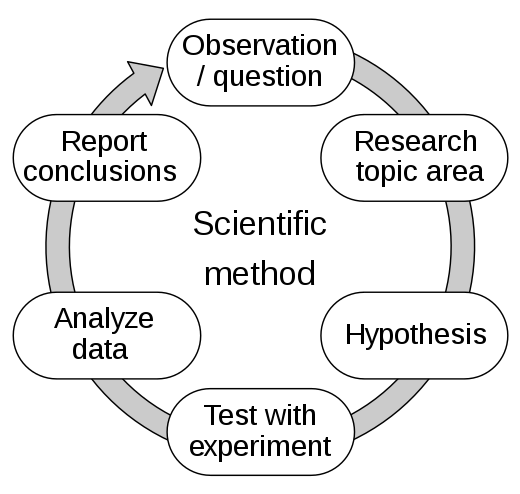
Figure 1.1: The scientific method illustrated as a research
cycle. This section gives a very broad overview of the major components of a
research cycle in cognition.
The research cycle involves a variety of methods–such as the scientific method– used to generate knowledge about cognition. The research process is represented as a cycle because the outputs of a research project can fuel the inputs of the next project. In general, the process of generating knowledge from a research cycle is incremental and involves many iterations, repetitions, and revisions.
A researcher today might begin with an observation–like, some food tastes delicious and other food tastes repulsive…I wonder why…– or, a question– like, how can a person learn to read faster? These observations and questions set the general topic for a research project.
Fortunately there is already a large literature on cognition spanning over a hundred years that can be consulted to learn more about the topic. The next step is to review existing findings on the topic that have been published in peer-reviewed scientific journals. This is accomplished by a literature review, which involves obtaining, reading, and critically evaluating primary research articles. Primary research articles are little units of scientific inquiry, each one contains a report about a specific research project. There are several internet search engines to help locate primary research, such as Google Scholar or Semantic Scholar.
Prior research can help you understand the current state of knowledge about a question. For example, if you were interested in the question, "Is it possible to learn how to improve my reading speed?", then, it would be very useful to read the existing literature on this question. One roadblock is that the literature is very large. Finding, reading, and critically evaluating all of the prior research about a particular question is time-consuming. However, engaging in this kind of scholarship is necessary for anyone, especially expert researchers, who intend to understand what is already known about a question before attempting to improve on that knowledge with a subsequent research project.
Even expert researchers may not have enough time to read all of the papers published on their topic of interest. Fortunately, another useful option is to read review articles that summarize a large number of individual research papers on a topic. For example, the review article, "So Much to Read, So Little Time, How Do We Read, and Can Speed Reading Help?" (Keith Rayner et al., 2016) describes numerous findings from the reading literature that are relevant to the question, "How can I learn to read faster?" The reference section of that review paper also lists each of the primary research articles that it discussed, providing another useful way to locate individual research papers. Unfortunately, based on that review paper, there are no known easy methods to dramatically improve reading speed without also sacrificing comprehension (the faster you read, the less you will comprehend).
After a researcher has familiarized themselves with the existing literature, they may come up with new ideas, questions, or hypotheses. For example, a general hypothesis could be that vision-based reading speed depends on visual processing speed. Perhaps, factors that make visual processing slow also cause reading speed to be slower, and factors that make visual processing fast cause reading speed to be faster. Ideally, a hypothesis should have testable implications that can be measured by an experiment.
Next, the hypothesis is put to a test with an experiment. The purpose of the experiment is to create a controlled situation where specific variables of interest can be manipulated to determine whether they influence the measurements. For example, a researcher might present words in different visual formats that may be processed more quickly or slower by the visual system. For example, some words could be presented in bold, and other words could be presented in italics. In this case, the manipulated variable is the visual format of the word, which could be bold or italics. The researcher may present words written in both visual formats to participants, and then use an apparatus to measure how long it takes them to read words in each format.
An experiment generates measurements in the form of data that is collected under different experimental conditions. A next stage in the cycle is to analyze the data, and determine whether the manipulations had any influences. For example, if visual format reliably influences visual processing and reading speed, then the data may show differences in reading speeds for words presented in bold or italic formats.
The research cycle ideally involves a community of peers, so the final stage of a research project is to report conclusions, or otherwise communicate the results of your research. This is typically done by writing up a research report and submitting it for peer-review to a journal. The peer-review process can help identify areas of improvement that the researcher may address in a revision. If the journal accepts the paper, then it becomes a part of the literature on that subject.
The research cycle is a process of figuring out what facts about cognition are real and in need of explanation, and then coming up with theories that explain the facts. The research cycle can be used to test claims, which can lead researchers to discover new facts and create new theories (i.e., a cyclical process). For example, the above researcher might find that presenting words in bold or italics doesn't change reading speed very much. This could inspire another researcher to manipulate the visual form of words in more extreme ways, which could help create new "reading-speed" optimized fonts, or fonts that are "easier" on the eyes, or that help people with dyslexia read more fluently.
Cognition research is also a human activity embedded within a socio-historical context. The discoveries of cognitive research can have applications in society (for better and worse), and the potential prospects of these applications can, in turn, influence the research process by guiding researchers to spend their time on some problems as opposed to others.
Experiments and measurements
This section provides examples of common measurement techniques in cognitive research. The examples are not exhaustive, but they illustrate the kinds of measurements that cognitive researchers make to answer questions about cognition.
QALMRI
QALMRI is a method for reading and writing about research. QALMRI stands for Question, Alternatives, Logic, Method, Results, and Inferences. QALMRI can be used as a method to read and understand a research article. It can also be used as a method to design and write a research article. The QALMRI method is described in detail below.
The QALMRI method is a useful tool for understanding research articles in cognitive psychology. It provides a systematic way to break down and analyze the key components of any research study. Let's examine each component:
Q stands for Question
Researchers ask and answer research questions. So, your first task is to identify what questions are being asked in the research article. Research questions are usually stated in the abstract or the introduction, and sometimes they are restated near the beginning of the general discussion.
You may notice many different kinds of questions being stated in a research paper. It is helpful to distinguish between broad questions and specific questions. A single research paper is rarely capable of answering very broad questions, but it may be able to answer a specific question.
A stands for Alternatives
When reading an experimental research paper on cognition, it is important to be able to identify the alternative explanations or hypotheses discussed in the document. It is possible that only one hypothesis is presented, while in other cases a paper may discuss multiple potential explanations. Either way, the hypothesis or alternative should be sufficiently detailed to draw an implication that can be tested by an experiment.
L stands for Logic
The logic of the alternatives or hypotheses is nearly identical to the hypotheses themselves, but more formally stated in terms of if/then statements. For example:
IF typists use an internal cognitive map that does not require feedback from the keyboard to guide their fingers, THEN typing performance should not be influenced by manipulations that remove tactile feedback, such as typing on keys versus a flat surface.
M stands for Method
The method refers to the tools used to answer the research questions. More specifically, the method is usually carefully designed to test the logical implications of alternative explanations. In experimental research, the method involves at least one independent variable or manipulation, and at least one dependent variable or measurement.
R stands for Results
The results are a final product of the research cycle. A given research article may present many results, depending on the complexity of the method. In general, the results refer to an analysis of whether the experimental manipulation impacted the measurements.
I stands for Inferences
Inference may be the most important product of a research project. Inferences connect the results back to the original research questions. So, what inferences about the alternative explanations under investigation can we draw based on the results of the research? Inferences are possible if the methods do a good job of testing the logic of the alternatives.
Writing a QALMRI assignment
Writing a QALMRI for any research paper involves writing short answers to each of the QALMRI points using clear and concise language. Your task is to answer these questions:
- Question: What was the broad question? What was the specific question?
- Alternative hypotheses: What were the hypotheses?
- Logic: If hypothesis 1 was true, what was the predicted outcome? What was the predicted outcome if hypothesis 2 was true?
- Method: What was the experimental design?
- Results: What was the pattern of data?
- Inferences: What can be concluded about the hypotheses based on the data? What can be concluded about the specific and broad question? What are the next steps?
Experimental Methods in Cognitive Psychology
Laboratory Experiments
- Controlled conditions: Manipulating specific variables
- Behavioral measures: Reaction time, accuracy, error patterns
- Advantages: High internal validity, precise control
- Limitations: May lack ecological validity
Neuroimaging Studies
- fMRI: Functional magnetic resonance imaging
- EEG: Electroencephalography
- PET: Positron emission tomography
- Advantages: Direct measurement of brain activity
- Limitations: Expensive, technical constraints
Computational Modeling
- Mathematical models: Describing cognitive processes
- Computer simulations: Testing theoretical predictions
- Advantages: Precise theoretical specification
- Limitations: May oversimplify complex processes
Case Studies
- Neuropsychological patients: Studying individuals with brain damage
- Rare conditions: Examining unusual cognitive phenomena
- Advantages: Detailed analysis of specific cases
- Limitations: Limited generalizability
Field Studies
- Natural settings: Studying cognition in real-world contexts
- Ecological validity: More representative of everyday cognition
- Advantages: High external validity
- Limitations: Less experimental control
Key Principles of Cognitive Research
Scientific Method
- Empirical evidence: Relying on observable data
- Replication: Confirming findings across studies
- Peer review: Scientific community evaluation
- Falsifiability: Theories must be testable
Ethical Considerations
- Informed consent: Participants understand the study
- Confidentiality: Protecting participant privacy
- Minimal risk: Avoiding harm to participants
- Debriefing: Explaining the study's purpose afterward
Validity and Reliability
- Internal validity: Confidence in causal relationships
- External validity: Generalizability of findings
- Reliability: Consistency of measurements
- Construct validity: Measuring what we intend to measure
Historical Development
Early Foundations
- Wilhelm Wundt (1832-1920): Established first psychology laboratory
- William James (1842-1910): Principles of Psychology
- Hermann Ebbinghaus (1850-1909): Scientific study of memory
Behaviorist Period
- John B. Watson (1878-1958): Focus on observable behavior
- B.F. Skinner (1904-1990): Operant conditioning
- Limitations: Ignored internal mental processes
Cognitive Revolution
- 1950s-1960s: Shift toward studying mental processes
- Computer metaphor: Mind as information processor
- Key figures: George Miller, Ulric Neisser, Donald Broadbent
Modern Cognitive Psychology
- Integration: Combining behavioral and neural approaches
- Technology: Advanced neuroimaging and computational methods
- Applications: Education, technology, clinical practice
Contemporary Challenges
Replication Crisis
- Some classic findings fail to replicate
- Emphasis on open science practices
- Pre-registration of studies
- Larger sample sizes
Individual Differences
- Moving beyond average performance
- Understanding cognitive diversity
- Personalized approaches to cognition
Ecological Validity
- Bridging lab and real-world cognition
- Mobile and wearable technology
- Natural behavior studies
Interdisciplinary Integration
- Cognitive neuroscience: Brain and behavior
- Computational cognitive science: Mathematical modeling
- Social cognition: Cultural and social factors
- Developmental cognitive science: Changes across lifespan
Findings, Effects, and Phenomena
Cognitive research has produced numerous findings and phenomena that help us understand how the mind works. These findings range from basic observations about cognitive processes to complex effects that reveal the underlying mechanisms of cognition.
The Stroop Effect
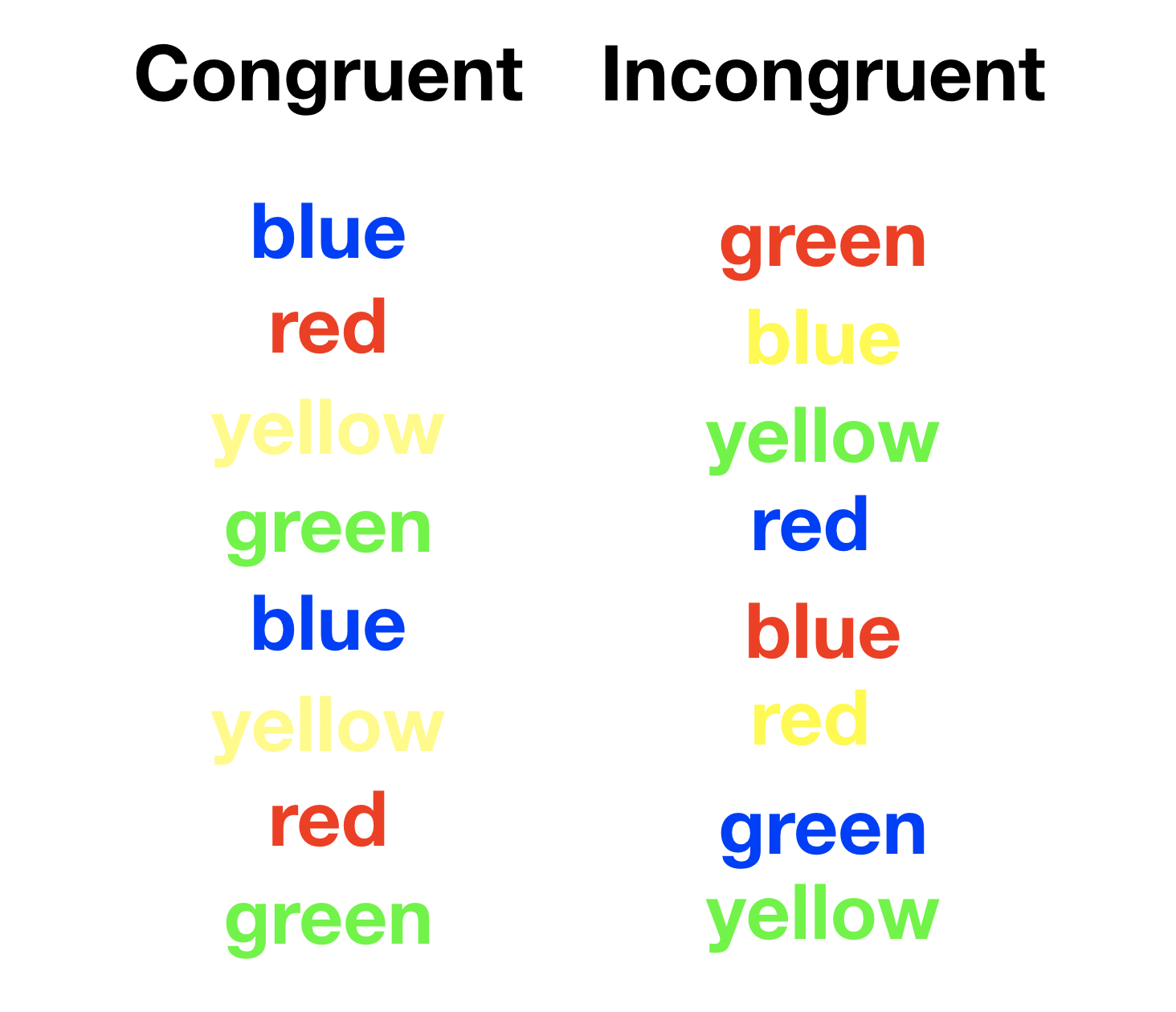
Figure 1.2: Example Stroop stimuli. Congruent stimuli display
the word in a matching ink color. Incongruent stimuli display the word in a
mismatching ink color.
The Stroop effect provides a useful example of a cognitive phenomenon. In a Stroop task, subjects are shown stimuli and asked to name the ink-color of the stimulus on each trial. For congruent stimuli, the ink-color matches the name of the word, like the word BLUE in the color blue. The correct answer for this stimulus is blue. For incongruent stimuli, the ink-color does not match the name of the word, like the word GREEN in the color red. The correct answer for this stimulus is red.
The typical finding is that participants are faster and more accurate to identify congruent than incongruent stimuli. This difference is termed the Stroop effect, which refers to the effect of the congruency manipulation on the reaction time or accuracy measure.
Applied vs. Theoretical Research
Some findings are useful discoveries in their own right that may translate into applications, even without attempts to explain the processes at work. For example, if a researcher found an effect of font size on reading speed, they could use the finding to display fonts in sizes that are optimized for reading quickly.
Other findings are used to make progress in understanding theoretical explanations of cognitive processes. For example, the Stroop effect may not have obvious applications for the real world, but hundreds of research papers have been published on it to test theoretical explanations of the effect.
Explanations, Theories, and Models
There is no single agreed-upon format for theories or models in cognition, so explanations take a variety of formats, from informal verbal theories to formal mathematical models. Explanations can also be aimed at different levels of analysis, and they are often metaphorical in nature.
One of the problems with explaining how cognition works is that cognitive systems– like people and animals– are extremely complex and made up of many interacting physical parts. The complexity makes a reductionist account of cognition very challenging, as there are so many parts to explain.
Levels of Analysis
Another approach to explanation in cognition invokes the concept of multiple levels of analysis. Vision scientist David Marr described three levels of analysis for the task of explaining visual perception from a computational perspective.
Marr likened visual processing to information processing in a computer system, and suggested that both should be understood in terms of three levels of analysis: computational, representational/algorithmic, and implementational/hardware.
Computational Level
The computational level refers to the overall goal of a process. For example, what is the purpose of an eyeball? At this level– and in the context of the rest of the visual system– the goal of eyeballs could be to transduce light photons into electrical signals for further processing.
Representational or Algorithmic Level
The representational or algorithmic level refers to how a goal is achieved. Representations are inputs and outputs of the process, while the algorithm is a set of instructions for transforming the inputs into the output.
Hardware Implementation Level
At the hardware implementation level, we consider how representations and algorithms are physically instantiated and implemented. For instance, what physical elements and processes enable an eye to convert light into electrical signals?
Metaphorical Models
Metaphorical models are also used for explanation in cognition. These refer to the process of mapping a simple model system as a metaphor for describing and understanding another more complex system.
For example, horse racing has been used as a model for explaining the Stroop effect. In a horse race, horses are lined up and wait for the starting signal before running down a track, with the first horse to reach the finish line declared the winner. This process is compared to the Stroop effect, in which a stimulus displaying a word and color is shown on the screen.
Importantly, word-naming is known to be faster than color-naming. In the metaphor, visual information for word recognition is a "faster horse" that gets to the finish line before color information. This metaphor provides language to describe why people might be faster to name the color of congruent than incongruent items.
Implications
Cognitive research has spanned a few centuries and has produced many theories, findings, and applications. However, not all implications have been uniformly positive for society, and some applications have negatively impacted certain groups of people. In light of this, it's important to periodically discuss socio-historical contexts surrounding the research and researchers.
For example, research on mental imagery ability and the early development of intelligence testing were impacted by the prevalent eugenics movement of the time. This era of psychology left a profound mark on subsequent cognitive research, raising essential questions about how psychological research should be applied in society.
Trust and Reproducibility
An overarching goal of the research cycle in the cognitive sciences is to create trustworthy knowledge about cognitive processes and abilities. There are multiple paths to creating knowledge that can be trusted, and the research cycle, along with experimental methods, is a common way to achieve good results. However, there are pitfalls to be aware of, and even the most rigorous experimental methods require critical evaluation.
What is Trustworthy Knowledge?
Trustworthy knowledge means that the general public should be able to trust claims that come from research published in the cognitive sciences. For example, if a research paper makes a claim about cognition, the evidence from the paper should be strong enough to support the claim.
It would be great if everyone could trust all the results from all published papers in psychology; however, there are several reasons why consumers of research findings should take a critical stance. Taking a critical stance means evaluating the details of the research oneself to determine whether the claims are supported by the evidence.
Reproducibility
A major concern in cognitive research is lack of reproducibility. Not all the findings in cognition, psychology, or other fields are reproducible. A finding is reproducible when another researcher can repeat an experiment and find the same pattern of results as the original researcher.
On the one hand, many findings in cognitive psychology are reproducible and can be trusted and accepted as facts. For example, there are hundreds of papers from multiple labs showing the Stroop effect in various contexts, providing overwhelming evidence that the Stroop effect exists.
Applications
To simplify the preceding discussion, the research cycle in cognition produces theory and phenomena that can lead to new applications and technology in the real world. For example, theory about how people learn skills can be used to modify training curricula and enhance the skill-learning process. Similarly, theory and findings about skills like reading explain why there are no easy shortcuts to learn to read faster.
Applications of Cognitive Psychology
Education
- Learning strategies: Evidence-based teaching methods
- Cognitive load theory: Managing mental effort
- Metacognition: Teaching students to think about thinking
Technology Design
- Human-computer interaction: User-friendly interfaces
- Artificial intelligence: Modeling human cognition
- Virtual reality: Understanding presence and immersion
Clinical Practice
- Cognitive assessment: Diagnosing cognitive disorders
- Cognitive rehabilitation: Treating brain injuries
- Cognitive-behavioral therapy: Changing thought patterns
Legal System
- Eyewitness testimony: Understanding memory limitations
- Decision-making: Jury and judicial processes
- Forensic psychology: Cognitive factors in criminal behavior
Future Directions
Emerging Technologies
- Brain-computer interfaces: Direct neural control
- Augmented reality: Enhancing cognitive abilities
- Machine learning: Analyzing large cognitive datasets
Global Perspectives
- Cross-cultural cognition: Cultural influences on thinking
- Diversity in research: Including varied populations
- International collaboration: Global research networks
Practical Applications
- Personalized medicine: Tailored cognitive interventions
- Aging populations: Supporting cognitive health
- Educational technology: Adaptive learning systems
Key Takeaways
- Cognition encompasses all mental processes involved in thinking and knowing
- Cognitive psychology uses scientific methods to study these processes
- Research follows a systematic cycle from observation to application
- Multiple methods provide different perspectives on cognitive phenomena
- The field continues to evolve with new technologies and approaches
- Applications span education, technology, clinical practice, and beyond
Learn More
- Mental Imagery
- Research Methods in Cognitive Psychology
- Attention and Working Memory
- Memory Systems
- Back to Cognition Psychology
- Learn More About History of Psychology
References
- Neisser, U. (1967). Cognitive Psychology. Appleton-Century-Crofts.