Mental Imagery
This chapter discusses historical and current research on mental imagery. Overarching questions include: What is mental imagery and how does it work? What kind of explanation would answer this question? How did prior researchers tackle these questions, and what has been learned about mental imagery? And, how has society been influenced by research into mental imagery? Two major topics include individual differences in mental imagery and the mental imagery debate.
What is Mental Imagery?
Mental imagery is the subjective experience of being in your own mind, particularly when using your imagination. Can you envision a picture, scene, or movie in your "mind's eye"? If so, how would you describe the quality of the mental image? Is it vivid and lifelike? If not, what is your experience when using your imagination?
Mental imagery: Imagined sensations of any type, including seeing pictures in your mind's eye, hearing a song in your head, using your inner voice, and others like imagined smell, touch, or a sense of space.
When I close my eyes, I have limited visualization ability. I can imagine visual scenes, especially familiar places like my kitchen. My imagery seems to be more spatial than visual, as I can feel the layout of the scene more easily than seeing visual features of the mental picture. Occasionally, my mental imagery is vivid and lifelike, particularly in dreams that can appear just as compelling as real life. So, according to me, my mental imagery ranges from fairly fuzzy to occasionally extremely vivid and lifelike.
The next section reviews evidence that people report a wide range of mental imagery abilities. For example, some people report the ability to effortlessly visualize extremely clear and vivid lifelike images. Some people report medium visualizing ability, whereas others report having very little to no mental imagery.
Generating Facts About Mental Imagery
Answering questions about mental imagery requires establishing facts about the phenomena that we can trust and collectively agree upon. However, the subjective aspects of mental imagery present difficulties for objectively measurement. Nevertheless, the literature contains methods and findings relevant to mental imagery phenomena, and because of the subjective nature of the topic, some skepticism is required for evaluating research results. We begin with the method of introspection.
Methods of Introspection and Subjective Report
The method of introspection involves self-reflection upon or scrutinizing aspects of your own cognition. For example, I used introspection to think about my own mental imagery experience in the previous section. Similarly, I used the method of subjective report to describe my experiences using a short paragraph. As a historical side note, introspection was used as a technique to generate knowledge about the mind by early German psychologist Wilhelm Wundt (1832-1920) and American psychologist Edward Titchener (1867-1927) who developed the structuralism school of psychology. Methods of subjective report remain very common today, often in the form of questionnaires that ask people to make various subjective judgments. Before considering the limitations of introspection and subjective report, let's see a concrete example from the beginning of mental imagery research.
Galton's Statistics of Mental Imagery
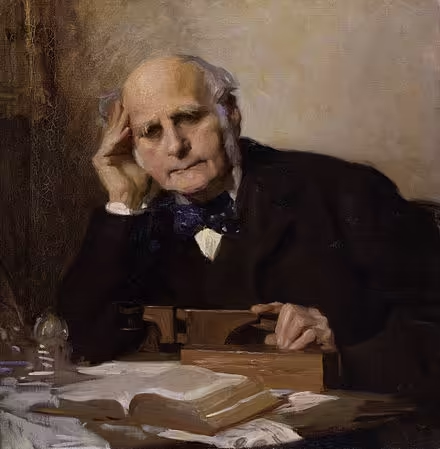
Sir Francis Galton (1822-1911) was a British psychologist who was one of the first to systematically study mental imagery. To quote from his 1880 paper titled, Statistics of mental imagery (Galton, 1880), Galton set out to:
"define the different degrees of vividness with which different persons have the faculty of recalling familiar scenes under the form of mental pictures, and the peculiarities of the mental visions of different persons".
The next section reviews Galton's methods and major findings. His original manuscript is freely available from archive.org.
Galton's Method of Subjective Report
Galton devised the "Breakfast Table Task" which involved a series of structured questions about mental imagery. He sent letters to 100 people asking them to reply with answers to his questions. The questions are reprinted below:
Galton's Breakfast table task questions:
"Before addressing yourself to any of the Questions on the opposite page, think of some definite object – suppose it is your breakfast-table as you sat down to it this morning – and consider carefully the picture that rises before your mind's eye. [p. 302]
- Illumination. – Is the image dim or fairly clear? Is its brightness comparable to that of the actual scene ?
- Definition. – Are all the objects pretty well defined at the same time, or is the place of sharpest definition at any one moment more contracted than it is in a real scene?
- Colouring. – Are the colours of the china, of the toast, bread-crust, mustard, meat, parsley, or whatever may have been on the table, quite distinct and natural?"
Galton's Results
Here are some of the answers from "100 men, at least half of whom are distinguished in science or in other fields of intellectual work." (reprinted from his original manuscript):
Cases where the faculty is very high:
- Brilliant, distinct, never blotchy.
- Quite comparable to the real object. I feel as though I was dazzled, e.g., when recalling the sun to my mental vision.
- In some instances quite as bright as an actual scene.
Cases where the faculty is mediocre: 46. Fairly clear and not incomparable in illumination with that of the real scene, especially when I first catch it. Apt to become fainter when more particularly attended to. 47. Fairly clear, not quite comparable to that of the actual scene. Some objects are more sharply defined than others, the more familiar objects coming more distinctly in my mind. 48. Fairly clear as a general image; details rather misty.
Cases where the faculty is at the lowest: 89. Dim and indistinct, yet I can give an account of this morning's breakfast table; – split herrings, broiled chickens, bacon, rolls, rather light coloured marmalade, faint green plates with stiff pink flowers, the girls' dresses, &c., &c. I can also tell where all the dishes were, and where the people sat (I was on a visit). But my imagination is seldom pictorial except between sleeping and waking, when I sometimes see rather vivid forms. 90. I am very rarely able to recall any object whatever with any sort of distinctness. Very occasionally an object or image will recall itself, but even then it is more like a generalised image than an individual image. I seem to be almost destitute of visualising power, as under control. 91. My powers are zero. To my consciousness there is almost no association of memory with objective visual impressions. I recollect the breakfast table, but do not see it.
Galton's Conclusion
Galton's major conclusion and potential discovery was evidence for a wide variety of individual differences in mental imagery. Some people reported having very strong powers of mental visualization, while others reported having moderate abilities, and still, others reported having no abilities to visualize anything in their mind's eye at all.
If Galton's results provide reliable facts, then explaining mental imagery becomes more challenging. Not only do we need to explain how individuals create mental images, but we also need to account for why some individuals can vividly create these images while others cannot. This illustrates the growing complexity that follows the research cycle. Every question answered leads to new facts, which in turn result in new questions requiring thorough explanation.
Limitations with Galton's Method
Galton's methods were straightforward. He wanted to know how different people experienced mental imagery, so he asked them to think about it and tell him. Although introspection and subjective report were good starting points they also have shortcomings that could invalidate the results. Consider the following limitations: Galton's participants could have lied about their mental imagery. Their statements could reflect fictional stories rather than facts about mental imagery abilities. The participants may have inaccurately described their own experiences. For example, descriptions could be exaggerated or contain mistaken impressions. People may use different words that suggest larger differences in mental imagery than actually exist.
Establishing facts about mental imagery is challenging because the subjective experience of a person's own mental imagery cannot be directly observed by others. In other fields of study, direct observation can help to establish a collective set of agreed-upon facts. For instance, a group of geologists can all observe and point to a rock formation, concur that it exists, and then analyze and measure it to gather additional directly observable information. Galton's subjective report technique does include some observable measurements, such as the words utilized by people to depict their mental imagery. However, people's verbal responses are an indirect attempt to communicate an experience and do not supply an objective perspective that other observers can use to witness the experience itself.
Obtaining objective facts about subjective experience is undoubtedly a challenge, but there are tools developed since Galton's to help make progress on these issues. One common requirement for establishing facts is to show that they are reproducible. In psychological research, a reproducible finding is one that reliably occurs when an exact or conceptually similar study is repeated by other researchers. The next section examines the reproducibility of Galton's core claims and findings.
Reproducing Galton's Mental Imagery Work
Galton conducted his work in the United Kingdom throughout the last half of the 1800s, and like some of his other ideas (that we will discuss in the next chapter), they spread among psychologists in other countries. At the turn of the century, American psychologists were busy using Galton's methods and publishing on the mental imagery abilities of college students. For example, Armstrong (1894) gave the "Breakfast Table Task" to students at Wesleyan University (a male college). The general pattern of results was similar to what Galton found. The students reported a wide range of mental imagery abilities, including a small proportion of students who were classified as having little to no visual imagery.
In 1902, French (1902) asked students at Vassar College (a women's college) about their mental imagery abilities using a longer mental imagery questionnaire created by Titchener (1905), that was intended to improve upon Galton's original questions. The results were mostly consistent with prior findings: the Vassar students reported a wide range of mental imagery abilities. However, one finding was not replicated: all 118 students reported having mental imagery abilities, and none claimed to have none. This could mean that all of the students happened to possess mental imagery abilities, or it could raise doubts about the claim that some people do not have mental imagery. One possibility is that the results depend on the questionnaire used. Galton had 10 questions on mental imagery, while Titchener had almost 90 questions that extended to other senses, and which could have given students additional opportunities to admit that they had at least some mental imagery. Perhaps, if Galton and Armstrong had used Titchener's new questionnaire, they too might have found all of their participants reporting at least some mental imagery ability.
Aphantasia and Hyperphantasia
Let's skip over a century and ask what recent research on mental imagery looks like. In 2010, Zeman and colleagues reported a case of a patient with "imagery generation disorder" (A. Z. Zeman et al., 2010) that was picked up by the media. Several people who heard about the finding contacted the researchers to let them know that they also did not experience visual imagery. This led the research group to begin examining these claims in more detail and in 2015 (A. Zeman et al., 2015), they did something very similar to what Galton did; namely, ask people questions about the vividness of their mental imagery. They used a newer questionnaire developed to assess the vividness of visual imagery (Marks, 1973) and gave it to the people who claimed they had no visual imagery. Perhaps not surprisingly, those same people gave answers to the questionnaire that were consistent with their claims that they had visual imagery. Zeman coined the term aphantasia to describe the condition of having little to no mental imagery.
The media attention to Zeman's work on aphantasia caused a great deal of interest across the world. One of the research participants in the 2015 study created the Aphantasia Network website, which has grown into a large online community for people with aphantasia. By 2020 (A. Zeman et al., 2020), Zeman's group had been contacted by 14,000 people who claimed they either had aphantasia, or the opposite – extremely vivid and life-like mental imagery, termed hyperphantasia. Some of the claims are quite extraordinary. For example, in a 2021 New York Times article (Zimmer, 2021), cognitive neuroscientist Joel Pearson claimed that 'hyperphantasia could go far beyond just having an active imagination…and that "People [with hyperphantasia] watch a movie, and then they can watch it again in their mind, and it's indistinguishable."'.
I can't accurately replay a whole movie in my head: that is pretty incredible. To me, this claim is so incredible that I wonder if the person was exaggerating their ability a little. Although I am skeptical, there is no shortage of people accomplishing astounding, and objectively verifiable feats of cognition. Daniel Tammet ("Daniel Tammet," 2021) is famous for breaking the European record for correctly reciting from memory the first 22,514 digits of the number pi. So, if Daniel Tammet can accurately "replay" the digits of pi for five hours, maybe someone else can replay a whole movie in their mind. Again, the role of direct observation comes into play for lending support to an extraordinary claim. The fact that Daniel could say the digits of pi out loud for other observers to hear, under controlled conditions (where those observers could verify he wasn't cheating somehow), makes it easier to believe that Daniel's ability is real. Similarly, if there were more direct methods to test claims about extreme differences in mental imagery abilities, this would lend more support to those extraordinary claims.
Theories, Explanation and Mental Imagery
Mental imagery research has generated several important theoretical debates and explanations for cognitive phenomena. One key area where mental imagery has been proposed as an explanatory mechanism is in understanding other cognitive abilities, particularly memory.
Mental Imagery and Memory
Allan Paivio conducted influential research examining the role of mental imagery in memory tasks. In one study (Paivio, 1963), participants were asked to learn pairs of words. Some word pairs consisted of concrete words (like "dog" and "chair") that are easy to form mental images of, while other pairs consisted of abstract words (like "justice" and "theory") that are more difficult to visualize.
Paivio found that participants were much better at remembering the concrete word pairs compared to the abstract word pairs. He proposed that this difference occurred because people could use mental imagery as an additional memory strategy for the concrete words. According to this explanation, when learning concrete word pairs, people form mental images of the objects and create visual associations between them, which provides an extra retrieval cue during memory testing.
Mental Scanning and Spatial Properties
Another important line of research has examined whether mental images preserve spatial properties similar to real visual perception. Kosslyn, Ball, and Reiser (1978) conducted a famous "mental scanning" experiment where participants first memorized a map of an island with various landmarks. Then, participants were asked to imagine focusing on one landmark and mentally "scan" to another landmark on the map.
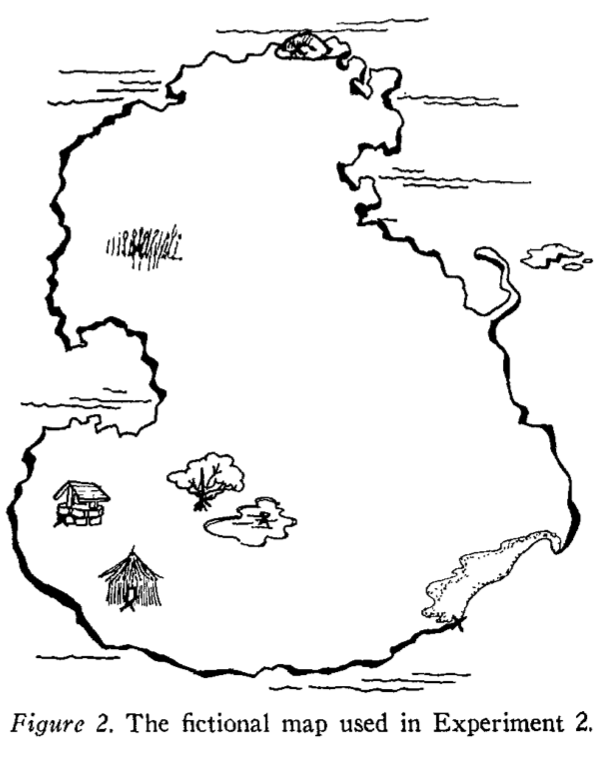
Figure: Kosslyn's participants used cartoon maps like this in his mental scanning experiments.
The key finding was that the time it took participants to mentally scan between landmarks was directly proportional to the actual distance between those landmarks on the map. This suggests that mental images might preserve metric spatial information, similar to how we process real visual scenes.

Figure: Kosslyn's original results showing the relationship between distance and scanning time.
Explaining Mental Scanning: Two Competing Theories
The mental scanning results have been interpreted in different ways, leading to one of the most important debates in cognitive psychology:
The Analogical (Imagery) Explanation
This view, championed by researchers like Stephen Kosslyn, proposes that mental images are analogical representations that preserve the spatial and visual properties of the objects they represent. According to this theory, mental scanning takes longer for greater distances because the mental image actually preserves the spatial layout, and mental attention must traverse the intervening space.
The Propositional Explanation
This alternative view, advocated by researchers like Zenon Pylyshyn (1973), argues that mental imagery is not based on picture-like representations but rather on abstract, language-like (propositional) representations. According to this theory, the mental scanning results occur not because people are actually scanning across a mental image, but because people have learned that greater distances should take longer to traverse, and they unconsciously simulate this knowledge when performing the mental scanning task.
This debate between analogical and propositional theories of mental imagery has been one of the most enduring and influential controversies in cognitive psychology, with important implications for understanding the nature of mental representation and cognitive processing.
Society and Historical Context
The study of mental imagery, like many areas of psychology, cannot be separated from its social and historical context. It's important to understand that some of the early researchers in this field, including Sir Francis Galton, held views and conducted research that we now recognize as problematic.
Galton's Broader Research Program
While Galton's work on mental imagery was groundbreaking, it was part of a larger research program that included highly controversial ideas about human intelligence and heredity. Galton was a strong proponent of eugenics - the belief that human populations could be "improved" through selective breeding based on perceived genetic superiority.
Galton believed that mental abilities, including intelligence and even moral character, were largely inherited. His research on mental imagery was connected to his broader interest in measuring and categorizing human mental abilities, which he hoped could be used to identify "superior" individuals for breeding purposes.
The Eugenics Connection
Galton's work on individual differences in mental imagery was influenced by his eugenic beliefs. He was interested in whether certain types of mental imagery abilities might be associated with higher intelligence or other "desirable" traits. This research was part of a broader scientific movement in the late 19th and early 20th centuries that sought to apply scientific methods to justify social hierarchies and discriminatory practices.
It's crucial to understand that these eugenic ideas were not just abstract theories - they had real-world consequences. Eugenic thinking influenced immigration policies, sterilization programs, and ultimately contributed to some of the worst atrocities of the 20th century.
Modern Implications
Today, we recognize that Galton's eugenic ideas were both scientifically unfounded and morally reprehensible. However, his methodological contributions to the study of individual differences, including his work on mental imagery, continue to influence psychological research.
This historical context serves as an important reminder that scientific research does not occur in a vacuum. The questions researchers choose to ask, the methods they use, and the interpretations they offer are all influenced by the social and cultural context of their time. As consumers of psychological research, it's important to maintain a critical perspective and consider how social biases might influence scientific conclusions.
Research Methods and Challenges
Methods of Introspection and Subjective Report
The study of mental imagery relies heavily on:
- Introspection: Self-reflection upon aspects of one's own cognition
- Subjective report: Describing experiences through questionnaires and verbal descriptions
Limitations
These methods have inherent limitations:
- Participants could provide inaccurate descriptions
- People may use different words suggesting larger differences than actually exist
- Subjective experiences cannot be directly observed by others
- Results depend on the quality of measurement tools
Reproducibility
Despite limitations, research has shown remarkable consistency:
- Across centuries and thousands of participants
- People consistently claim mental imagery is real to them
- Similar proportions report different kinds of mental imagery abilities
- Results replicate across different cultures and time periods
Implications and Applications
Educational Applications
- Understanding how students with different imagery abilities learn
- Developing teaching methods that accommodate various cognitive styles
- Using visualization techniques in learning and memory
Clinical Applications
- Assessing imagery abilities in neurological patients
- Understanding conditions like aphantasia and hyperphantasia
- Therapeutic applications of guided imagery
Technological Applications
- Designing interfaces for people with different imagery abilities
- Virtual reality and augmented reality considerations
- Brain-computer interfaces and neural prosthetics
Current Research Directions
- Neuroimaging studies: Using fMRI and EEG to study brain activity during imagery
- Genetic factors: Investigating hereditary aspects of imagery abilities
- Developmental studies: How imagery abilities change across the lifespan
- Cross-cultural research: Examining imagery across different cultures
- Computational modeling: Creating models of mental imagery processes
Key Takeaways
- Mental imagery abilities vary dramatically among individuals
- These differences have been consistently documented for over a century
- Some people have no conscious visual imagery (aphantasia)
- Others have extremely vivid imagery (hyperphantasia)
- Research methods face challenges due to the subjective nature of imagery
- Understanding imagery differences has important practical applications
Learn More
- Attention and Working Memory
- Memory Systems
- Research Methods in Cognitive Psychology
- Back to Cognition Psychology
- All Psychologists — browse the full biographical collection.
Test Your Mental Rotation Skills
Explore your own mental imagery abilities with the Mental Rotation Task:
Try the Mental Rotation Task →
References
- Paivio, A. (1971). Imagery and Verbal Processes. Holt, Rinehart and Winston.