Information Processing
The information processing approach emerged as a revolutionary framework in psychology during the 1950s and 1960s, fundamentally changing how researchers conceptualized mental processes. This chapter explores the historical development of information processing theories and their impact on cognitive psychology.
Four Revolutions and Cognitive Metaphors
The development of information processing psychology was influenced by four major revolutions:
Industrial Revolution: Assembly-Line Metaphor
The assembly-line metaphor suggested that cognitive processes could be understood as a series of sequential stages, each performing specific operations on information before passing it to the next stage.
Technological Revolution: Telephone Metaphor
The telephone system provided a metaphor for understanding how information could be transmitted, processed, and received, introducing concepts of channels, capacity, and interference.
Digital Revolution: Computer Metaphor
Computers offered the most influential metaphor, suggesting that the mind could be understood as an information processing system with inputs, processing units, storage, and outputs.
Cognitive Revolution
These technological metaphors converged to create the cognitive revolution, fundamentally shifting psychology from behaviorist to information processing approaches.
Donders' Processing Stages
The Subtractive Logic
Franciscus Donders (1868) pioneered the measurement of mental processing stages using reaction time methods. His subtractive logic involved:

Figure 7.1a: Simple reaction time
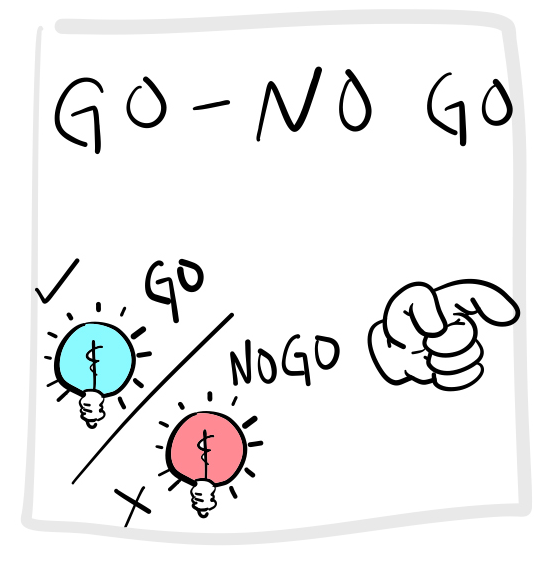
Figure 7.1b: GO-NO GO task
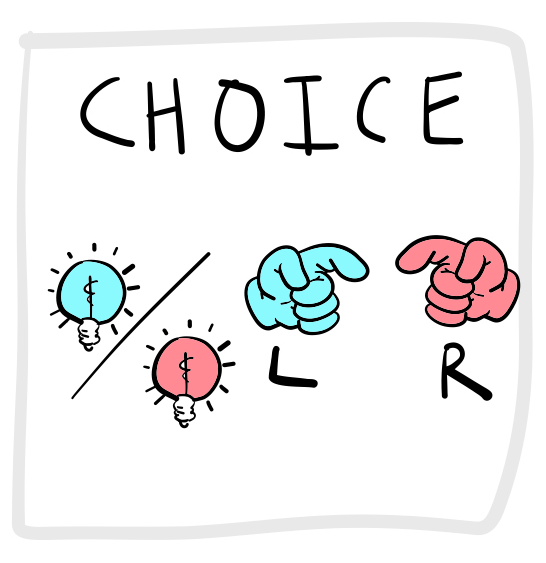
Figure 7.1c: Two-alternative forced choice
- Simple Reaction Time: Respond to a single stimulus
- GO-NO GO Task: Respond to one stimulus, withhold response to another
- Two-Alternative Forced Choice (2AFC): Choose between two different responses
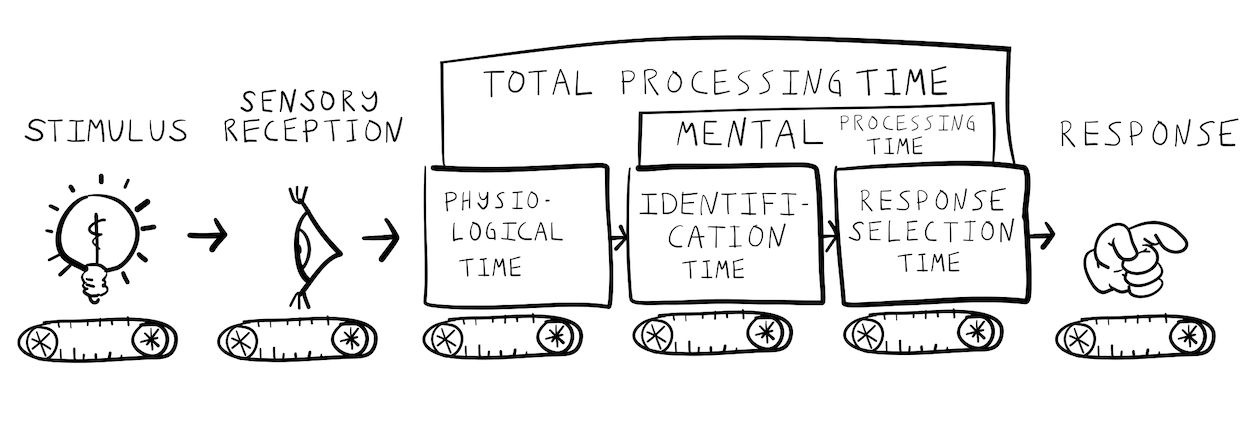
Figure 7.2a: Assembly line metaphor
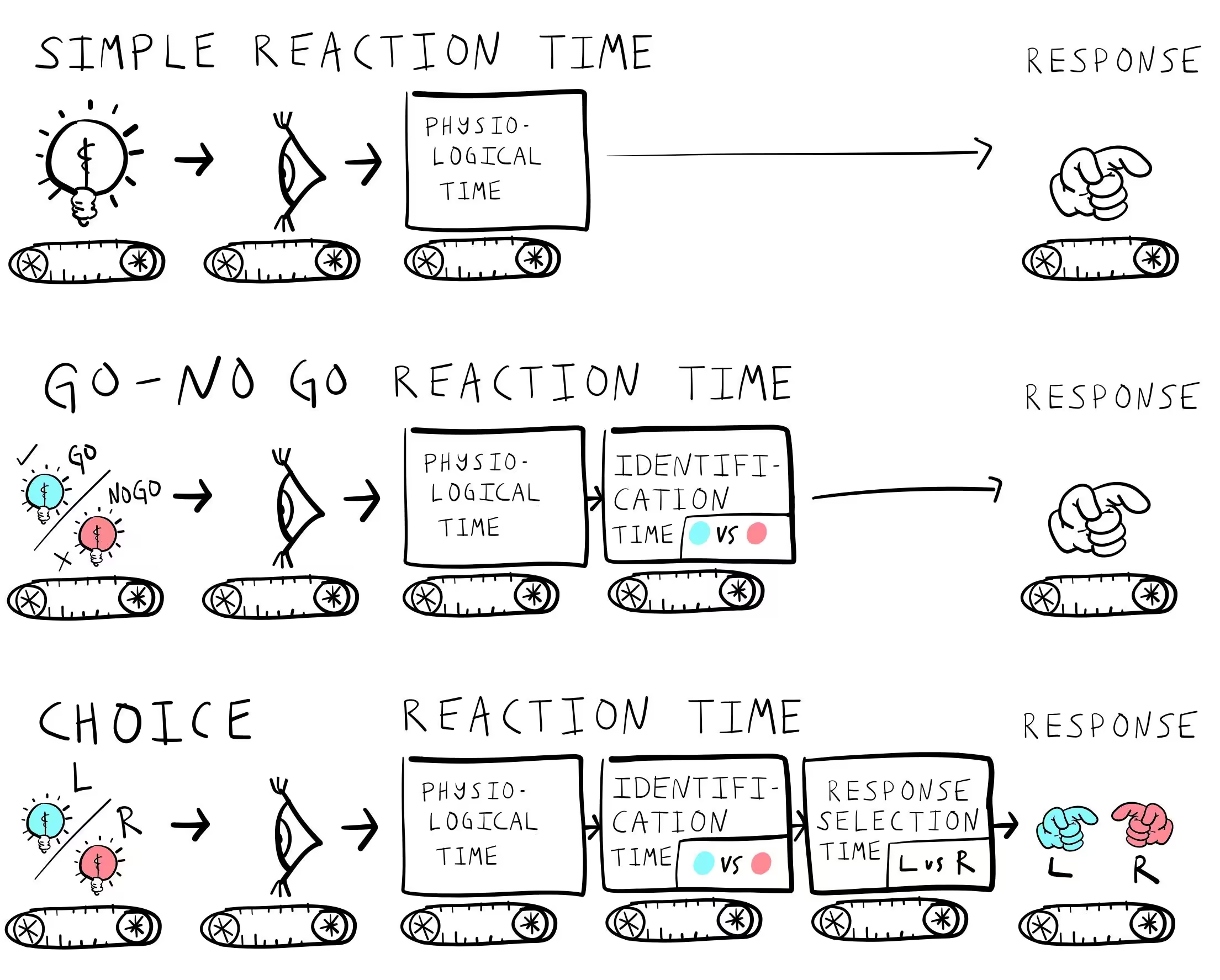
Figure 7.2b: Task processing stages
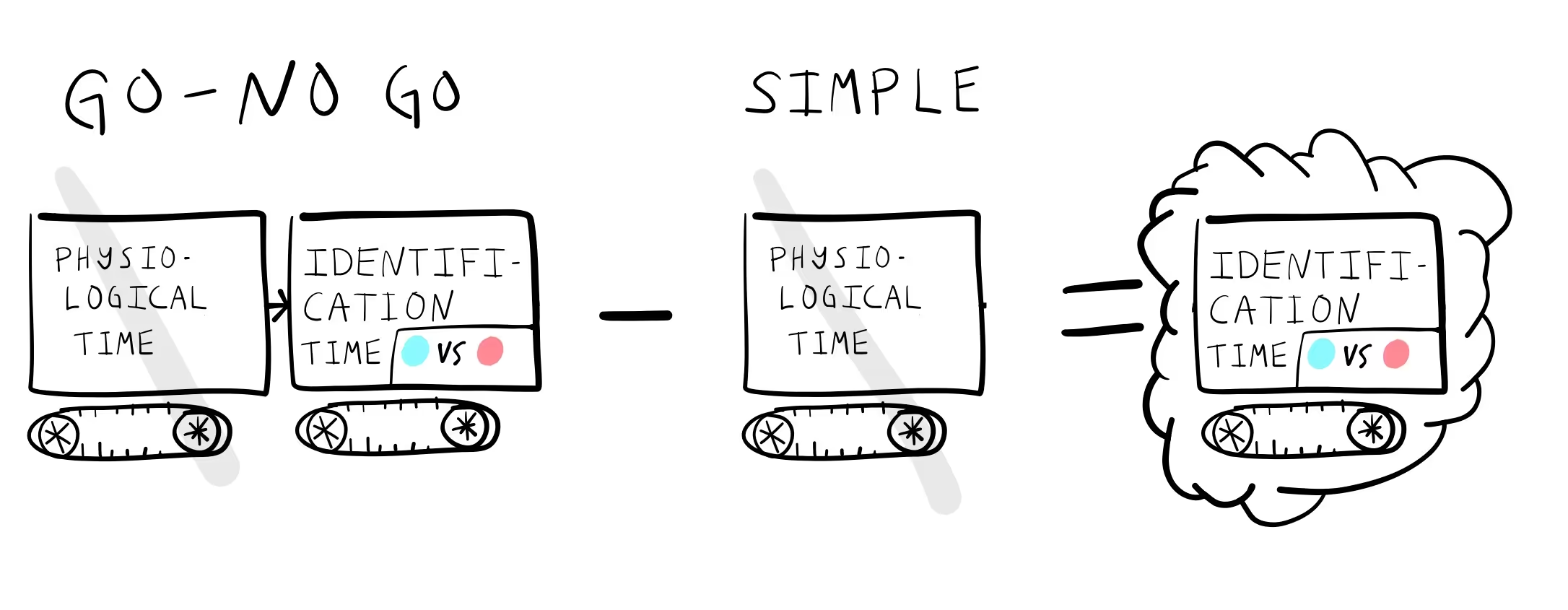
Figure 7.3a: Identification time
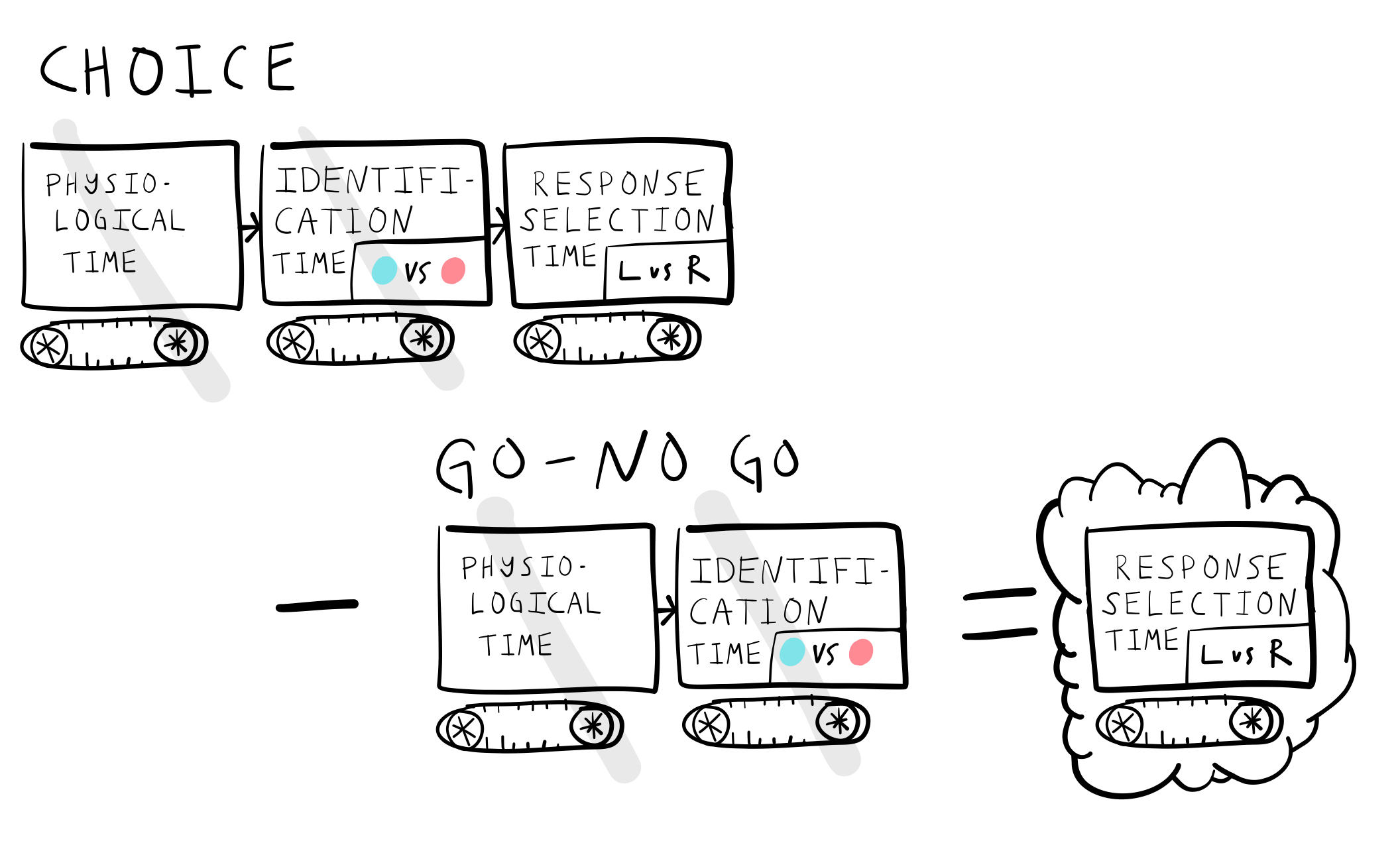
Figure 7.3b: Reaction time analysis
By subtracting reaction times between conditions, Donders aimed to isolate the time required for specific mental processes like stimulus identification and response selection.
Criticisms and Limitations
Donders' approach faced several criticisms:
- Serial vs. Parallel Processing: Assumed sequential rather than simultaneous processing
- Unpredictable Stages: Mental stages might not be additive
- Task Complexity: Different tasks might engage different processes
Sternberg's Additive-Factors Logic
Saul Sternberg developed an alternative approach using additive-factors logic, examining how different experimental manipulations interact to reveal underlying processing stages.
The Psychological Refractory Period (PRP)
The Psychological Refractory Period (PRP) effect demonstrates the bottleneck in human information processing. When two stimuli are presented in rapid succession, the response to the second stimulus is delayed, suggesting that certain processing stages cannot operate in parallel.

Figure 7.4: PRP effect showing delayed response to second
stimulus

Figure 7.5: Bottleneck model explaining PRP
Key Findings:
- Stimulus Onset Asynchrony (SOA): The time between the first and second stimulus
- PRP Effect: Increased reaction time to the second stimulus at short SOAs
- Bottleneck Theory: Central processing stages create a bottleneck that prevents parallel processing
This finding supported the idea of a single-channel, limited-capacity central processing mechanism.
Cybernetics and the Macy Conferences
The interdisciplinary Macy Conferences (1946-1953) brought together researchers from various fields to discuss cybernetics - the study of control and communication in animals and machines. These conferences were crucial in:
- Establishing information theory as a framework for understanding cognition
- Promoting interdisciplinary collaboration
- Developing concepts of feedback, control systems, and information processing
Shannon's Information Theory

Figure 7.6: Shannon's communication model

Figure 7.7: Information theory framework
The Communication Model
Claude Shannon's mathematical theory of communication provided a quantitative framework for measuring information. His model included:
- Sender: Source of information
- Message: Information to be transmitted
- Channel: Medium of transmission
- Receiver: Destination of information
- Noise: Interference in transmission
Measuring Information in Bits
Shannon introduced the concept of measuring information in binary digits (bits). The amount of information (H) in a message is calculated using:
H = -Σ P(xi) × log₂ P(xi)
Where P(xi) is the probability of each event occurring.
Key Principles
- Maximum Information: Occurs when events are equally probable and unpredictable
- Minimum Information: Occurs when events are completely predictable
- Predictability and Information: More predictable messages carry less information
Examples of Information Calculation
- Four equally probable events: H = 2 bits (maximum uncertainty)
- Unequal probabilities: H < 2 bits (some predictability)
- One certain event: H = 0 bits (no uncertainty)
The Hick-Hyman Law
Choice Reaction Time Research
Choice reaction time tasks involve presenting one of several possible stimuli and requiring participants to make the appropriate response as quickly as possible.
The Discovery
William Hick (1952) and Ray Hyman (1953) independently discovered that reaction time increases linearly with the amount of information (measured in bits) in the stimulus set, not simply with the number of alternatives.
Experimental Design
Hyman's crucial experiment separated the effects of:
- Number of alternatives: How many different stimuli were possible
- Information content: How predictable each stimulus was
Key Findings
- Linear Relationship: Reaction time increased linearly with information content (bits)
- Information vs. Alternatives: Information content, not just the number of alternatives, determined reaction time
- Predictability Effects: More predictable stimuli led to faster responses
The Hick-Hyman Law
Reaction Time = a + b × H
Where:
- a = intercept (baseline processing time)
- b = slope (processing rate)
- H = information content in bits
Implications for Behaviorism
The Hick-Hyman law posed significant challenges to behaviorist theory:
- Beyond Stimulus-Response: Responses were influenced not just by the presented stimulus, but by the entire set of possible stimuli
- Expectation Effects: Performance was affected by expectations about what stimuli might appear
- Mental Operations: The findings implied intervening mental processes between stimulus and response
- Mathematical Framework: Information theory provided a quantitative approach to studying mental processes
Information Theory and Beyond
Shannon's information theory had profound implications for psychology:
Applications
- Attention Research: Understanding selective attention as information filtering
- Memory Studies: Conceptualizing memory as information storage and retrieval
- Decision Making: Analyzing choices in terms of information processing
- Perception: Understanding sensory processing as information extraction
Limitations and Criticisms
- Semantic Content: Information theory focused on statistical properties, not meaning
- Human vs. Machine: Humans process information differently than machines
- Context Effects: Human information processing is highly context-dependent
- Parallel Processing: Humans can process multiple information streams simultaneously
Legacy and Impact
The information processing approach fundamentally transformed psychology by:
- Providing Quantitative Methods: Offering mathematical tools for studying mental processes
- Bridging Disciplines: Connecting psychology with computer science, engineering, and mathematics
- Enabling Cognitive Psychology: Laying the groundwork for the cognitive revolution
- Influencing Modern Research: Continuing to influence contemporary cognitive neuroscience and artificial intelligence
Conclusion
The development of information processing theories marked a crucial transition in psychology from behaviorist to cognitive approaches. By providing mathematical frameworks for understanding mental processes, researchers like Donders, Shannon, Hick, and Hyman established the foundation for modern cognitive psychology. Their work demonstrated that mental processes could be studied scientifically and quantitatively, paving the way for the cognitive revolution that would transform psychology in the latter half of the 20th century.
The information processing approach continues to influence contemporary research in cognitive psychology, neuroscience, and artificial intelligence, demonstrating the enduring value of understanding the mind as an information processing system.
References
- Neisser, U. (1967). Cognitive Psychology. Appleton-Century-Crofts.