Intelligence Testing in Psychology
Editorial Note: This chapter examines the complex and often troubling history of intelligence testing, including its deep connections to the eugenics movement. While intelligence tests have legitimate scientific and educational applications, their historical misuse has caused significant harm to marginalized communities. This content is presented for educational purposes to understand both the scientific development and social consequences of psychological testing.
This chapter covers the development of intelligence tests, examples of early intelligence tests and how they work, discussion of the concept of intelligence in relation to these tests, and historical examples of how the tests were used in the context of the eugenics movement.
Key Questions
- How did intelligence testing develop as a scientific discipline?
- What were the motivations behind early intelligence tests?
- How did eugenics ideology influence the development and application of mental testing?
- What were the social consequences of intelligence testing in education, military, and mental health?
- How did marginalized communities respond to discriminatory testing practices?
The Intelligence Test Race
The Stanford-Binet test was among the first intelligence tests to be widely adopted and used in America. Alfred Binet (1857-1911) was a French psychologist who published the Binet-Simon test (with his student Theodore Simon) in 1905, which described revised intelligence tests Binet was working on for over a decade prior. Lewis Terman was an American psychologist at Stanford University, who helped popularize Binet's test in America, hence Stanford-Binet.
It is convenient to start with the Stanford-Binet test, because Terman and Binet represent somewhat dueling progressive notions (for the time) about how psychological science could and should be used to improve society. These dueling notions involve the nature/nurture debate about the heritability and fixed or flexible nature of mental abilities; and the implications of that debate for enacting social policy.
Terman's Eugenic Vision
In the early 1900s, countries were finding ways to respond to social issues (crime, education, mental healthcare) with social institutions and policies. The eugenics movement, of which Terman was a strong proponent, billed itself as a progressive movement capable of fixing society's ailments. From Terman's perspective, intelligence tests would have obvious benefits for negative and positive eugenics policies:
Negative Eugenics Applications:
- Mental testing would make institutionalization more effective at segregating "unwanted" people from society
- Terman predicted that "intelligence tests will bring tens of thousands of these high-grade defectives under the surveillance and protection of society"
- He believed this would "ultimately result in curtailing the reproduction of feeble-mindedness and in the elimination of an enormous amount of crime, pauperism, and industrial inefficiency"
Positive Eugenics Applications:
- Intelligence testing could identify hidden geniuses and groom them to become national leaders
- Terman wrote: "The number of children with very superior ability is approximately as great as the number of feeble-minded. The future welfare of the country hinges, in no small degree, upon the right education of these superior children."
Binet's Alternative Approach
Binet did not presume that mental abilities were fixed or inherited, and he argued that presumptions about human intelligence were premature in the absence of rigorous tests providing objective evidence. Binet was hired by the French government to address pressing issues in education.
Binet's Concerns:
- Without objective mental tests, French schoolchildren were already being divided into "normal" and "defective" categories
- Existing methods for deciding children's fate were deeply flawed, arbitrary, and open to bias
- Some normal children were accidentally being institutionalized for wrong reasons
- Educational resources could be wasted on children not capable of learning
Binet's Vision:
- Education could improve mental abilities, even of "sub-normal" children
- Science could accurately test every person for their aptitudes
- Society could assign people to tasks with utmost efficiency
- These goals required a scientifically accurate intelligence test
Early Mental Testing Attempts
Cattell's Mental Tests (1890)
James McKeen Cattell published "Mental tests and Measurements" in 1890. Like Galton, Cattell was also a proponent of eugenics. Cattell proposed measuring each person on ten tests:
- Dynamometer Pressure (hand strength)
- Rate of Movement (hand speed)
- Sensation-areas (distinguishing pin-pricks)
- Pressure causing Pain
- Least noticeable difference in Weight
- Reaction-time for Sound
- Time for naming Colours
- Bi-section of a 50 cm line
- Judgment of 10 seconds time
- Number of Letters remembered on once Hearing
Cattell's tests ranged across physical and mental abilities, but none measured a complicated concept like human intelligence. By 1896, Cattell had collected extensive data on Columbia University students, including:
- Physical measurements (hair/eye color, height, weight, head size)
- Sensory abilities (vision, hearing, touch)
- Cognitive measures (reaction time, memory, mental imagery)
- Examiner judgments of student quality
- Detailed family and medical history questionnaires
Binet's Critiques of Early Approaches
Binet criticized the early approaches to mental testing, arguing that they failed to measure complex mental processes that constitute intelligence. He advocated for tests that would assess higher-order cognitive functions rather than simple sensory and motor abilities.
The Binet-Simon Test (1905-1911)
Motivation
Binet was commissioned by the French government to develop objective methods for identifying children who needed special educational assistance. The goal was to replace subjective and biased assessment methods with scientific testing.
Method
The Binet-Simon test introduced several revolutionary concepts:
Age-Based Norms:
- Tests were designed to measure abilities typical of different age groups
- Children's performance was compared to age-appropriate expectations
- This allowed for identification of developmental delays or advances
Complex Cognitive Tasks:
- Unlike Cattell's simple sensory tests, Binet included complex reasoning tasks
- Tests measured comprehension, judgment, reasoning, and problem-solving
- Tasks increased in difficulty and complexity
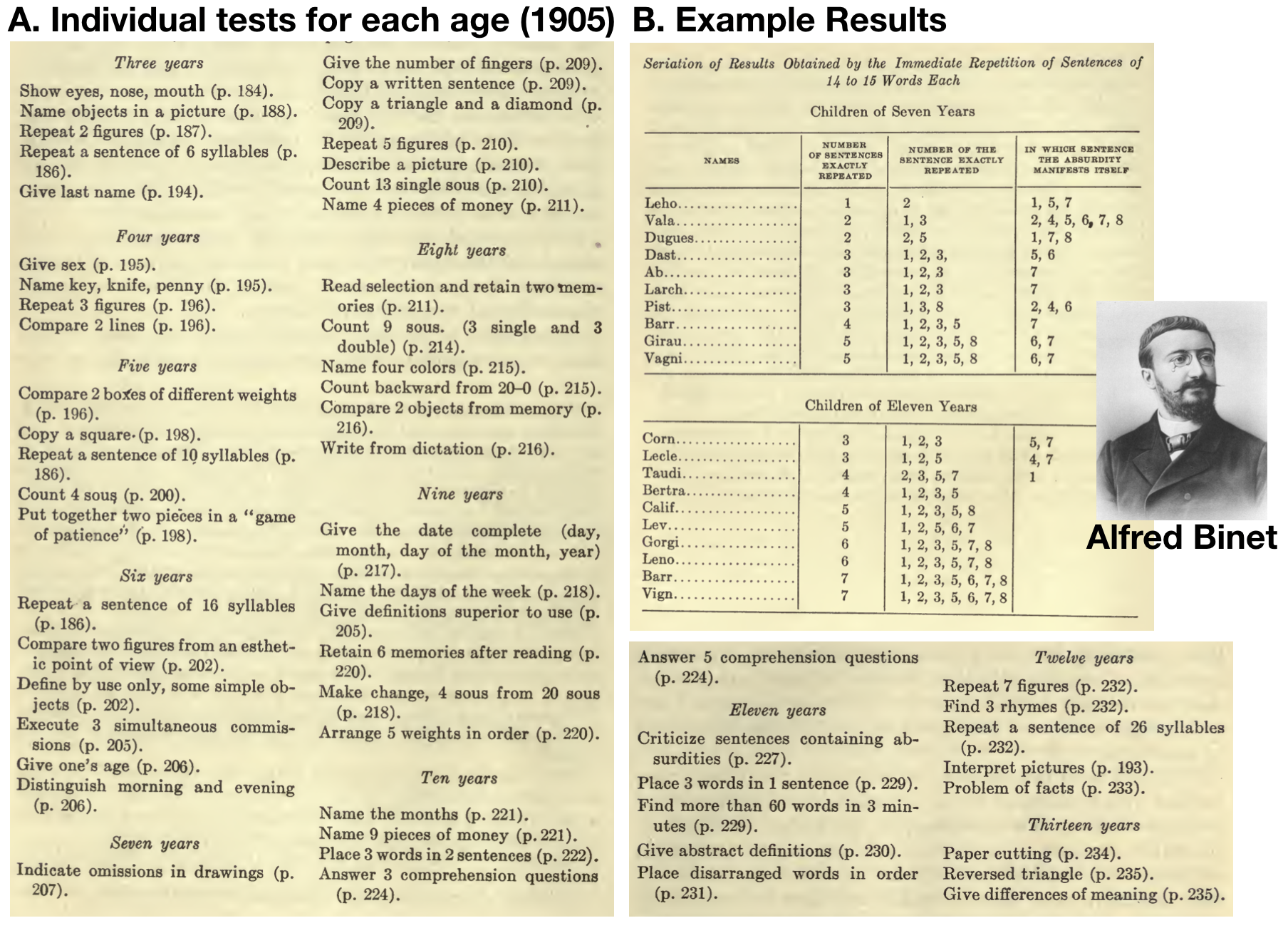
Figure: Examples of questions and results from Binet's mental testing procedure. The figure shows individual tasks that were determined to be appropriate for children in each year, from 3 to 13, along with sample results demonstrating age-related performance differences and individual variations within age groups.
Quantifying Mental Ability with Age
Binet introduced the concept of "mental age" - the chronological age at which a child's performance was typical. This allowed for:
- Objective comparison between children
- Identification of developmental patterns
- Educational planning based on cognitive readiness
Computing Intelligence Scores
The intelligence quotient (IQ) was later developed by German psychologist William Stern:
IQ Formula: IQ = (Mental Age / Chronological Age) × 100
- Average intelligence: IQ = 100
- Above average: IQ > 100
- Below average: IQ < 100
Binet's Use Cases
Binet envisioned several applications for his test:
- Educational Assessment: Identifying children needing special instruction
- Objective Evaluation: Replacing subjective teacher judgments
- Resource Allocation: Efficiently distributing educational resources
- Child Welfare: Preventing inappropriate institutionalization
Meaning of the Measure
Binet was cautious about interpreting his test results:
- He viewed intelligence as complex and multifaceted
- He believed mental abilities could be developed through education
- He warned against using tests to label children permanently
- He emphasized the test's limitations and need for careful interpretation
Mental Testing and Eugenics in America
The Alpha-Beta Test
During World War I, American psychologists developed group intelligence tests for military use:
Army Alpha Test:
- Written test for literate recruits
- Included analogies, arithmetic, and general knowledge
- Used to classify soldiers for different roles
Army Beta Test:
- Non-verbal test for illiterate recruits
- Used pictures and symbols instead of words
- Attempted to measure "innate" intelligence
Results and Interpretation:
- Tests showed differences between ethnic groups
- Eugenicists interpreted results as evidence of racial hierarchies
- Alternative explanations (education, language, cultural bias) were largely ignored
Scientific Racism
Intelligence tests became tools for promoting racist ideologies:
Misuse of Test Data:
- Group differences were attributed to genetic inferiority
- Environmental factors were minimized or ignored
- Results were used to justify discriminatory policies
Immigration Restrictions:
- Test results influenced immigration quotas
- Certain ethnic groups were deemed "undesirable"
- Scientific veneer was given to racist policies
Mental Health Applications
The eugenics movement deeply impacted mental health policy:
Classification Systems:
- "Idiots": mental age of 2-year-olds
- "Imbeciles": mental age of 3-7 year-olds
- "Morons": mental age of 8-12 year-olds (term invented by Goddard)
Policy Consequences:
- Forced sterilization of people deemed "feeble-minded"
- Institutionalization based on test scores
- Segregation from mainstream society
Henry Goddard's Role:
- Director of Vineland Training School
- Translated Binet's work into English
- Promoted eugenic applications of testing
- Advocated for identifying and controlling "morons"
Education and The Black Psychologists
Intelligence testing became widespread in education through standardized testing:
Educational Sorting:
- Tests used to track students into different educational paths
- Superior children received more resources
- "Inferior" children received limited educational opportunities
Achievement Gaps:
- Testing revealed differences between ethnic groups
- Gaps were often attributed to innate differences rather than systemic inequalities
Formation of ABPsi (1968):
The Association of Black Psychologists was formed to address concerns about testing:
ABPsi's Position on Testing:
The organization opposed tests that were used to:
- Label Black children as uneducable
- Place Black children in special classes
- Provide inferior education
- Assign Black children to lower educational tracks
- Deny higher educational opportunities
- Destroy positive intellectual growth and development
Advocacy and Reform:
- Called for moratorium on testing in 1969
- Challenged biased testing practices
- Promoted culturally fair assessment methods
- Achieved moratorium on intelligence testing of Black children in California (1979)
Modern Implications: Testing Abilities vs. Testing Theories
This historical context raises important questions about how scientific research contributes to society:
Lessons Learned
Scientific Responsibility:
- Researchers must consider social implications of their work
- Tools can be misused even when developed with good intentions
- Scientific findings require careful interpretation and application
Ongoing Vigilance:
- Testing continues to have positive and negative outcomes for different groups
- Cultural bias in assessment remains a concern
- Educational and employment decisions based on testing require scrutiny
Contemporary Cognitive Psychology
Modern cognitive psychology has shifted focus:
From Classification to Understanding:
- Tests are used to understand how cognition works
- Focus on testing theories rather than ranking people
- Emphasis on cognitive processes rather than fixed abilities
Methodological Improvements:
- Better control for cultural and linguistic factors
- Recognition of multiple intelligences
- Dynamic assessment approaches
- Consideration of contextual influences
Key Takeaways
Historical Context Matters: Intelligence testing developed within the context of eugenics, which shaped its early applications and interpretations.
Scientific Tools Can Be Misused: Even well-intentioned scientific developments can be applied in harmful ways when influenced by social prejudices.
Multiple Perspectives: Binet's educational focus differed significantly from Terman's eugenic applications of the same basic testing principles.
Social Consequences: Intelligence testing had profound impacts on education, immigration, mental health policy, and civil rights.
Ongoing Relevance: The legacy of early intelligence testing continues to influence contemporary debates about assessment, education, and social policy.
Importance of Advocacy: Marginalized communities, particularly Black psychologists, played crucial roles in challenging discriminatory testing practices.
Scientific Evolution: Modern cognitive psychology has learned from this history to focus on understanding mental processes rather than ranking human worth.
Related Topics
- Eugenics and Psychology
- Research Methods in Cognitive Psychology
- What is Cognition?
- Thinking and Reasoning
Self-assessment & Experiments
This chapter draws from historical sources and contemporary scholarship to provide a comprehensive view of intelligence testing's development and impact. Understanding this history is essential for responsible practice in psychological assessment and cognitive research.
References
- Cattell, J. M. (1890). Mental tests and measurements. Mind, 15(59), 373-381.
- Binet, A., & Simon, T. (1905). Méthodes nouvelles pour le diagnostic du niveau intellectuel des anormaux. L'Année Psychologique, 11, 191-244.
- Terman, L. M. (1916). The measurement of intelligence. Houghton Mifflin.
- Goddard, H. H. (1912). The Kallikak family: A study in the heredity of feeble-mindedness. MacMillan.
- Yoakum, C. S., & Yerkes, R. M. (1920). Army mental tests. Henry Holt.