Eugenics and Psychology
This chapter describes the eugenics movement and some connections to the larger discipline of psychology and research into cognition. Some of these connections are expanded upon in later chapters, including the next chapter on mental testing.
Editorial Note: Throughout this chapter we will encounter descriptions of people from the perspective of eugenics. For example, eugenics differentiated people on the basis of human characteristics that eugenicists decided were desirable or undesirable. As a result, people who had eugenically desired traits were labelled as "high-quality" or "superior" compared to people who had eugenically undesired traits, who were labelled as "low-quality" or "inferior". These and other similar descriptors of human beings will sometimes be used in this chapter for the purpose of describing dehumanizing aspects of eugenics ideology.
Eugenics, Psychology and the Cognitive Sciences
Including a chapter about eugenics is not very common in introductory psychology textbooks. When many people learn about histories of psychology and cognitive psychology, the topic of eugenics is rarely discussed. One reason for the lack of coverage might be that cognitive psychology and the cognitive sciences became established academic disciplines well after the primary eugenics movements had come and gone; and, eugenics may be viewed as "ancient history" or irrelevant to discussions of modern day cognitive sciences.
However, the rise and gradual fall of the eugenics movement is inextricably intertwined with psychology, especially around the turn of the 20th century and even into the 1950s. Although the modern cognitive sciences were established between the 1950s and 1980s, research into cognitive abilities had been ongoing for decades prior to the so-called "cognitive revolution". The eugenics movement substantially influenced early branches of research into cognitive abilities, and shaped the kinds of questions, tools and methods, and applications that the research enterprise held for society.
Key Questions
- What was the eugenics movement?
- How did it get started, what did it do, when did it end?
- How was psychology involved?
- What does eugenics have to do with cognition?
These questions are explored across this chapter and the next chapter on intelligence testing.
Eugenics: An Overview
In the previous chapter on mental imagery, we learned that Sir Francis Galton was interested in mental abilities because of his research into individual differences in the vividness of mental imagery. However, we did not elaborate on the fact that Galton was also interested in eugenics, which motivated him to conduct the research in the first place.
Basic Principles of Eugenics
Galton began publishing articles that were formative to eugenics as early as 1865. Eugenics transitioned from ideas about "improving society" in journal pages read by small groups of academic elites, into a large and complex social movement that was broadly accepted– from everyday citizens to national leaders– in numerous countries around the world up until the 1940s and 50s.
A basic idea in eugenics was that society could be improved and its problems solved by selectively breeding humans, just like other animals. Eugenicists made several key assumptions:
- Heritability of Traits: Traits they considered desirable, like human "intelligence," were inherited from parents
- Selective Breeding: Society as a whole could become more intelligent over generations by breeding intelligent people with each other
- Elimination of "Undesirable" Traits: Traits they considered undesirable, like "feeble-mindedness," were inherited from parents and could be eliminated by preventing people deemed undesirable from having offspring
Impact and Consequences
The eugenics movement established itself in many countries and sought to enact social policies to further the aims of the eugenics movement. Their policies were responsible for many human rights violations and atrocities. The remnants of eugenics campaigns have left lasting impacts on society that continue today.
Psychology's Involvement
The early discipline of psychology was complicit in eugenics and large numbers of psychologists were eugenicists. The general involvement of psychology reflects the widespread acceptance of eugenics in society (psychology wasn't special in this regard). It was the specific aspects of psychology's involvement that warrants the descriptor "complicit".
The eugenics movement needed ways to "scientifically" measure physical and mental qualities of individual people. Psychologists helped create and deploy the tests of human ability (e.g., intelligence tests) that would be used to carry out eugenics campaigns on society. Research concerned with cognitive abilities was motivated and deeply entrenched in eugenics for well over half a century (1900s-1950s).
Galton's Eugenics
Eugenics was a potent mix of ideas ranging from scientific claims, social policy, religion, and visions of Utopia. Although eugenics ideology morphed over time and geographical place, the basic tenets of the movement are still captured well by Galton's early writings.
Early Writings
In 1865, Galton wrote "Hereditary talent and character," a short paper that was expanded to a book a few years later, "Hereditary Genius" (1869). These works describe:
- Galton's ideas about human quality: that some humans are much more superior in quality than others
- His research claiming heritability: that the most important human qualities are hereditary (biologically inherited from parents)
- His fears about society: that society was degrading all around him
- His plan to save society: by creating a new scientific religion capable of engineering a supreme human race over generations, simply by controlling human reproduction
The Dog Breeding Analogy
Galton referenced the practice of dog breeding, which involves selectively mating dogs with particular physical and behavioral traits over generations of broods. Dog-breeding was a choice example, because it would have been obvious to anyone that breeding over generations can produce dramatic results: all of the many different dog breeds have been achieved through breeding.
One of Galton's radical claims for the time, was that breeding should be used on humans, just like dogs, and that breeding programs would be a simple, straightforward, and already well-understood method to produce a superior race of humans over generations.
Historical Context
Galton's eugenics ideas did not appear in a vacuum, and they were influenced by the scientific and social context he was working in:
Scientific Influences
- Darwin's Theory of Evolution: Galton's eugenics writings appeared just after Charles Darwin (his cousin) published the theory of evolution in the Origin of the species (1859)
- Natural Selection: Darwin's theory explained how animal species evolved over time through a process of natural selection
Social and Political Context
- British Imperialism: This time period included threats to British imperialism and efforts by many nations to establish their dominance
- Social Hierarchies: Galton was an esteemed upper-class British man of science who held sexist and racist views common among his peers
- Racial Assumptions: Long before genetics would show that there is no biological basis for race, academics like Galton assumed that people from so-called "uncivilized" countries were of much lower quality than people from "civilized" countries
Malthusian Fears
In the tradition of Thomas Malthus – who is famous for speculating about the imminent collapse of society as a result of population growth– Galton feared that society would deteriorate over the generations due to increased global interactions between people across the world. Specifically, Galton feared that "natural selection" left to chance would allow inferior, low-quality and uncivilized people to reproduce, pollute the gene pool, spread undesirable genes across the world, and cause the slow decline and ultimate destruction of the human race.
Eugenics as a "Solution"
Galton saw eugenics as a way to wrest his vision for human destiny from natural selection, and use the new powers of science and technology to save humanity from itself. Eugenics was not just concerned with improving society for one generation; it would be marketed as a quasi-religious movement dedicated to enhancing humanity across generations, for the rest of time.
Critical Questions
Although improving humanity might not seem like a frightening goal, it is worth considering questions like:
- What is being improved?
- Who gets to decide what needs improving?
- What changes count as improvement?
- Who will benefit from the improvement?
- Will the costs of improvement be shared equally?
In answering these questions, the eugenics movement argued that improving humanity meant identifying and eliminating eugenically low quality humans from the species; which is a frightening prospect for large groups of people who were dehumanized by eugenicists.
The Eugenics Movement
Galton's eugenics ideas could have stayed on the page, like most dystopian science fiction novels, but unfortunately they took on a life of their own. The scale of eugenics can be established by examining its dimensions as a social movement.
Timeline and Development
The eugenics movement developed through several key phases:
- 1860s-1880s: Galton's foundational writings
- 1890s-1910s: International spread of ideas
- 1910s-1930s: Peak popularity and implementation
- 1940s-1950s: Decline following World War II
From Ideas to Internationalization
What started as academic papers by Galton in Britain quickly spread to other countries, particularly the United States and Germany. The movement gained momentum through:
- Academic networks: Professors and researchers spreading ideas
- Popular publications: Making eugenics accessible to the general public
- Political adoption: Government officials embracing eugenic policies
Conferences and Popularity
The eugenics movement organized international conferences that brought together scientists, politicians, and social reformers. These conferences helped:
- Legitimize eugenic "science"
- Coordinate policies across countries
- Share "best practices" for eugenic programs
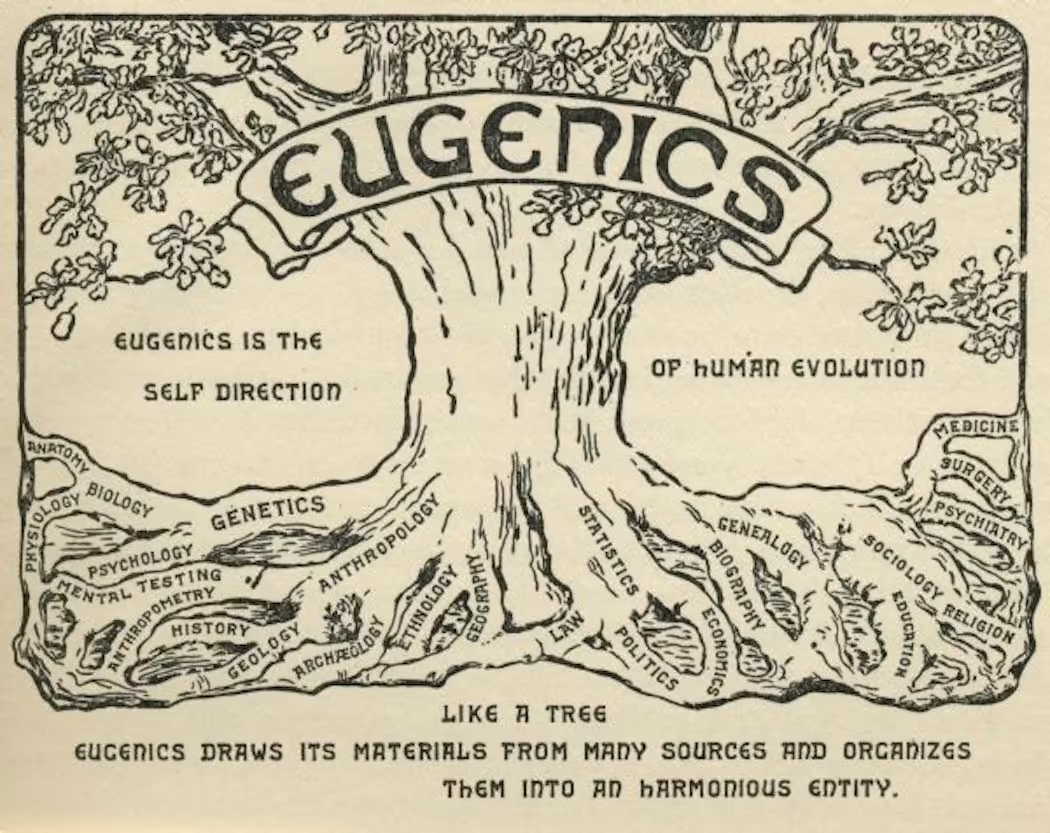
Figure: The Tree of Eugenics was created as a conference logo for the second International Eugenics Congress. It depicts how the movement saw itself as "the self-direction of human evolution" that would harmoniously integrate many fields of study for the purpose of bettering mankind.
There were many national and international conferences where elites in the eugenics movement gathered to popularize and discuss eugenic solutions to improve society. The first national conference on race betterment was held in Battle Creek Michigan in 1914. The first (1912), second (1921) and third (1932) International Eugenics Congresses were held in London, and New York (last two). The tree of eugenics shown above was created for the second conference and illustrates how each academic field listed in the roots had their own eugenics legacies to contend with.
Eugenics Journals
Specialized journals were created to publish eugenic research and promote the movement's goals. These publications gave an air of scientific legitimacy to what were often ideologically driven conclusions.
Positive and Negative Eugenics
The movement developed two main approaches:
Positive Eugenics
- Encouraging reproduction among people deemed "superior"
- Providing incentives for "desirable" people to have more children
- Marriage counseling based on eugenic principles
Negative Eugenics
- Preventing reproduction among people deemed "inferior"
- Forced sterilization programs
- Marriage restrictions
- Immigration controls
Influences on Society
The eugenics movement had profound and devastating impacts on society across multiple domains.
Eugenics and Mental Health
People with mental health conditions were among the first targets of eugenic policies:
- Institutionalization: Mass confinement in asylums
- Forced sterilization: Preventing reproduction
- Dehumanization: Treating people as genetic "defects"
Eugenics and Racism
Eugenics provided a pseudo-scientific justification for racism:
- Racial hierarchies: Ranking different ethnic groups
- Immigration restrictions: Limiting entry of "undesirable" groups
- Segregation policies: Separating racial groups
Eugenics and Fertility Control
Eugenic policies directly controlled human reproduction:
- Sterilization laws: Forced sterilization of "unfit" individuals
- Marriage laws: Prohibiting certain marriages
- Birth control: Selective access to contraception
Eugenics and Education
Educational systems were used to promote eugenic ideology:
- Curriculum content: Teaching eugenic principles
- Intelligence testing: Sorting students by "ability"
- Vocational tracking: Limiting educational opportunities
Eugenics and Genocide
The most extreme manifestation of eugenic thinking was genocide:
- Nazi Germany: The Holocaust as the ultimate eugenic program
- Other genocides: Eugenic justifications for mass killings
- Ethnic cleansing: Removing "undesirable" populations
Psychology and Eugenics
The relationship between psychology and eugenics was deep and troubling, with lasting implications for the field.
Emergence of Psychology
Psychology emerged as a scientific discipline during the height of the eugenics movement. This timing was not coincidental – many early psychologists were motivated by eugenic goals:
- Individual differences research: Measuring and categorizing human abilities
- Intelligence testing: Creating tools to identify "superior" and "inferior" individuals
- Heredity studies: Investigating the genetic basis of mental traits
Leadership by Eugenicists
Many prominent early psychologists were active eugenicists:
- Professional organizations: Eugenicists held leadership positions in psychological associations
- Academic institutions: Universities hired and promoted eugenic researchers
- Research funding: Eugenic organizations funded psychological research
Psychological Tools in Service of Eugenics
Psychologists developed and refined tools that were used to implement eugenic policies:
- Intelligence tests: Used to identify people for sterilization
- Personality assessments: Evaluating "character" and "fitness"
- Family studies: Tracing "defective" heredity
Modern Reckoning
The psychological community has begun to acknowledge its historical complicity in eugenics:
APA's Apology to People of Color
In 2021, the American Psychological Association issued a formal apology to people of color for psychology's role in promoting racism and discrimination. The apology acknowledged:
- Psychology's contribution to systemic racism
- The harm caused by biased research and practice
- The need for ongoing efforts to address these issues
Implications for Modern Cognitive Science
understanding the eugenic roots of psychology has important implications for modern cognitive science:
Critical Evaluation of Research
- Historical awareness: Understanding how past biases shaped research questions and methods
- Methodological scrutiny: Examining research for hidden assumptions and biases
- Ethical considerations: Ensuring research serves all of humanity, not just privileged groups
Ongoing Vigilance
- Contemporary issues: Recognizing how eugenic thinking persists in modern forms
- Genetic research: Ensuring genetic studies don't revive eugenic ideologies
- AI and technology: Preventing algorithmic bias from perpetuating discrimination
Positive Directions
- Inclusive research: Ensuring diverse participation in cognitive studies
- Social justice: Using cognitive science to promote equality and understanding
- Ethical frameworks: Developing guidelines to prevent future abuses
Key Takeaways
Historical Connection: The eugenics movement was deeply intertwined with early psychology and cognitive research
Scientific Legitimacy: Eugenicists used the authority of science to justify discrimination and violence
Widespread Impact: Eugenic policies affected millions of people across multiple countries and decades
Professional Complicity: Many psychologists actively participated in and promoted eugenic ideology
Lasting Legacy: The effects of eugenic thinking continue to influence society and science today
Ongoing Responsibility: Modern cognitive scientists must remain vigilant against bias and discrimination in research
Ethical Imperative: Understanding this history is essential for ensuring that cognitive science serves all of humanity
Related Topics
- Intelligence Testing - How eugenic ideology shaped the development of IQ tests
- Research Methods - Ethical considerations in psychological research
- What is Cognition? - The broader context of cognitive science
This chapter provides a critical examination of the historical connections between eugenics and psychology. Understanding this history is essential for recognizing how social and political contexts can influence scientific research, and for ensuring that modern cognitive science serves the interests of all people rather than perpetuating discrimination and inequality.
References
- Galton, F. (1869). Hereditary Genius. Macmillan.