Anna Freud
Introduction
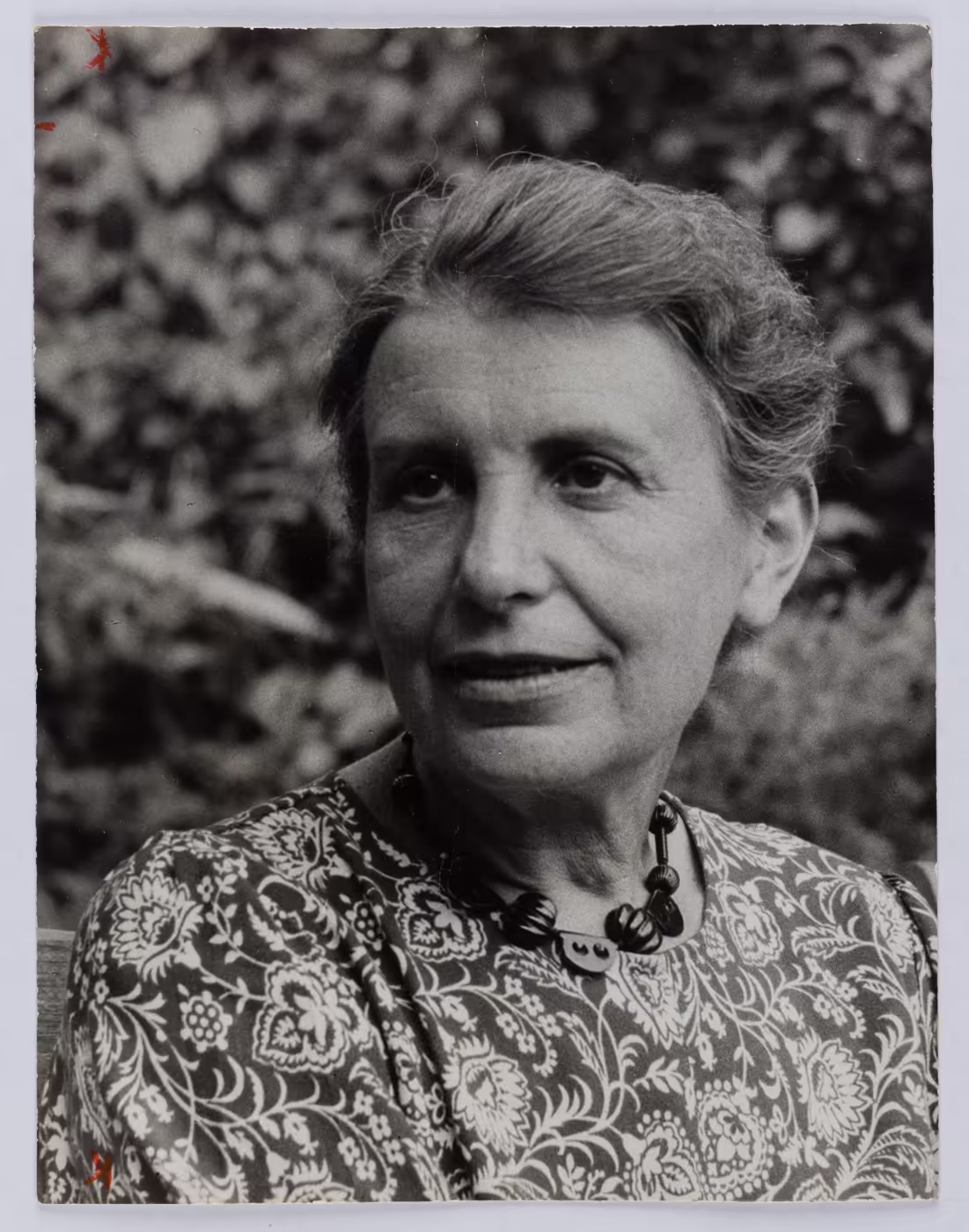
Anna Freud (3 December 1895 – 9 October 1982) was a psychoanalyst who did more than anyone else to turn the treatment of children into a distinct branch of psychoanalysis. The youngest of the six children of Sigmund Freud and Martha Bernays, she had no university degree in medicine or psychology; her professional training was as an elementary school teacher, and she entered analysis as her father's patient before becoming his colleague, secretary and, eventually, the guardian of his legacy. Working alongside Hermine Hug-Hellmuth and Melanie Klein, she helped establish child analysis as a discipline, but she did so on terms that differed sharply from Klein's. Where Klein interpreted children's play as the equivalent of adult free association, Anna Freud insisted that a child's ego and superego are still forming, that the analyst cannot rely on a transferential bond with a young patient, and that observation of normal development must ground any judgment about pathology.
Her 1936 book The Ego and the Mechanisms of Defence turned a scattered set of clinical observations into a catalogue of the manoeuvres by which the ego protects itself, and it remains the standard reference work on defence mechanisms. After escaping Nazi-occupied Vienna in 1938 she rebuilt her life in London, running wartime nurseries for displaced children and founding the Hampstead Child-Therapy Clinic, an institution that combined treatment, training and research and that still bears her name.
Early Life and Education
Anna Freud was born in Vienna on 3 December 1895, the sixth and last child of Sigmund Freud and Martha Bernays. Biographers describe a childhood in which she felt neglected by a mother preoccupied with the household and fiercely rivalrous with her older sister Sophie. Her father recorded her arrival in a letter to Wilhelm Fliess in 1899 with the remark that "Anna has become downright beautiful through naughtiness."
She left school early and trained as a primary school teacher, beginning to teach in Vienna in 1917. The career was cut short by a bout of tuberculosis; during the long convalescence she read her father's writings and decided to become a psychoanalyst. Her own training analysis was conducted by her father, an arrangement that was not unusual in the small Viennese circle of the day but that no analytic institute would permit now, and that critics have cited when arguing that her theory of defence was shaped by a relationship in which open conflict was difficult to acknowledge.
She was admitted to the Vienna Psychoanalytic Society in 1922 after presenting a paper on beating fantasies and daydreams, joined the executive board of the Vienna Psychoanalytic Institute in 1925 and began working as a training analyst. She served as General Secretary of the International Psychoanalytical Association from 1927 to 1934 and was its Honorary President from 1973 until her death. Her closest emotional attachments were to women, above all Dorothy Tiffany Burlingham, daughter of the painter Louis Comfort Tiffany, whom she met in 1925 and with whom she lived and worked for the rest of her life, and the writer Lou Andreas-Salomé. Historians have debated whether these relationships were sexual; Anna Freud denied that they were, and no direct evidence has been produced. The French historian Élisabeth Roudinesco nonetheless argued that the structure of her emotional life influenced her clinical conservatism.
Academic and Professional Career
In 1927 Anna Freud published Introduction to the Technique of Child Analysis, which set out her view that the child analyst must combine interpretation with education and that a therapeutic alliance with a child has to be built rather than assumed. The book was attacked by Klein and her British supporters, and the exchange established the two camps whose rivalry dominated British psychoanalysis in the following decade. In the same year she helped found the so-called Matchbox Schools, which applied psychoanalytic ideas to progressive education, and in 1937 she opened the Jackson Nursery in Vienna for severely deprived toddlers.
After the Anschluss of March 1938 the Freud family left Vienna for London with the help of Ernest Jones. Anna Freud settled at 20 Maresfield Gardens in Hampstead, the house that remained her home and workplace until her death, and from 1941 she and Burlingham ran the Hampstead War Nurseries for children separated from their families by bombing and evacuation. Staff were required to write detailed daily observations of the children, which were discussed each evening; this routine generated two books, Young Children in War Time (1942) and Infants Without Families (1943), and it supplied the empirical discipline that later distinguished her work from more speculative strands of psychoanalysis.
In 1945 a group of six young survivors of the Theresienstadt concentration camp arrived in Britain. Anna Freud and Sophie Dann studied them intensively and published the results in 1951 as "An Experiment in Group Upbringing," a landmark account of children who had formed intense attachments to one another in the absence of parents. She founded the Hampstead Child-Therapy Training Course and Clinic in 1947 to pursue three aims at once: training in child analysis, a clinic for children and adolescents, and a programme of research. The clinic opened at 12 Maresfield Gardens in the early 1950s, and she became its director in 1952, a post she held until her death.
Her 1965 volume Normality and Pathology in Childhood set out the framework of "developmental lines" and is widely credited with helping to establish developmental psychopathology. From 1961 she was associated with the Yale Law School, and with the legal scholar Joseph Goldstein and the child psychiatrist Albert J. Solnit she wrote Beyond the Best Interests of the Child (1973) and Before the Best Interests of the Child (1979), books that pressed courts and child-welfare agencies to place the continuity of a child's attachments at the centre of custody decisions. She was appointed CBE in 1967, received honorary degrees from Clark University (1950) and, in 1980, from Harvard University and the Johann Wolfgang Goethe University in Frankfurt, and received the Goethe Prize of the Federal Republic of Germany in February 1982. She died in London on 9 October 1982.
Major Contributions to Psychology
The ego and its mechanisms of defence
The Ego and the Mechanisms of Defence (1936; English translation 1937) shifted analytic attention from the id and its impulses to the ego and its strategies of self-protection. Anna Freud enumerated and illustrated a long list of defences, including repression, regression, reaction formation, isolation, undoing, projection, introjection, turning against the self, reversal, sublimation and denial in fantasy. Her central claim was that defences are not merely pathological: they are the ordinary equipment with which a developing person manages instinctual demands, external danger and internal conflict, and the clinician's task is to identify which defences a patient habitually uses rather than simply to dismantle them. The book gave later psychodynamic therapy its vocabulary and supplied the basis for the "defence mechanisms" entry in diagnostic manuals.
Child analysis as a distinct technique
Anna Freud argued that children are not small adults on the couch. Because their personalities are still forming and they remain dependent on their parents, they do not develop a full transference neurosis, and the analyst cannot simply interpret; the analyst must also act as an auxiliary ego, helping the child to tolerate feelings and to keep development moving. She was sceptical of the claim that a child's play is equivalent to free association and preferred simple, cautious interpretations. This position put her in direct opposition to Klein, whose supporters equated play with free association and argued for deep interpretation from an early age. The disagreement culminated in the "controversial discussions" held by the British Psychoanalytical Society during the Second World War, which ended in an institutional compromise that left Viennese, Kleinian and independent groups sharing a single society.
Developmental lines
In Normality and Pathology in Childhood (1965) she proposed that a child's progress can be charted along several partially independent "developmental lines," each tracing a move from dependency to emotional self-reliance: from suckling to rational eating, from wetting and soiling to bladder and bowel control, from irresponsibility to responsibility in body management, from play to work, and from egocentricity to companionship. The clinical payoff was that a symptom could now be assessed against the child's position on several lines rather than read off a single developmental stage, so that normality and pathology could be compared within one framework.
Identification with the aggressor
Among the defences she described, identification with the aggressor has had the longest afterlife. Drawing on observations of terrified children in the Hampstead nurseries, she showed how a frightened person may cope with a threatening figure by taking on that figure's aggression, converting a passive position into an active one. The mechanism has since been used to understand cycles of abuse and the re-enactment of victimisation.
The child's perspective in law and policy
With Goldstein and Solnit she developed the idea of the "psychological parent" and the standard of the "least detrimental alternative," arguing that legal decisions should minimise damage to a child's ongoing attachments rather than adjudicate the rights of adults. The books were enormously influential in family law and in child-welfare practice in the United States and Britain.
Major Publications
- Introduction to the Technique of Child Analysis (1927)
- The Ego and the Mechanisms of Defence (1936; English translation 1937)
- Infants Without Families (1943), with Dorothy T. Burlingham
- The Psycho-Analytical Treatment of Children (1946)
- Normality and Pathology in Childhood: Assessments of Development (1965)
- Beyond the Best Interests of the Child (1973), with Joseph Goldstein and Albert J. Solnit
- Before the Best Interests of the Child (1979), with Joseph Goldstein, Albert J. Solnit and Sonja Goldstein
She also published, with Sophie Dann, the study "An Experiment in Group Upbringing" in The Psychoanalytic Study of the Child (1951), based on six children who had survived Theresienstadt.
Impact and Legacy
Anna Freud's most durable legacy is institutional. The Hampstead Clinic was renamed the Anna Freud Centre in 1984 and, through partnerships with University College London, spawned the Child Outcomes Research Consortium and the Evidence Based Practice Unit, bodies that do exactly what she insisted was possible: subject psychoanalytic treatment to systematic outcome measurement. The Anna Freud National Centre for Children and Families has also run the UK Trauma Council and the National Centre for Family Hubs. Her insistence that children have a distinct psychological life requiring specially trained practitioners underpins the profession of child psychotherapy in Britain.
Her theoretical legacy has proved more open to question than her institutional one. The evidence for the effectiveness of child psychoanalysis remains thin: much of it rests on clinicians' own reports, and reviews have found the benefits modest, and greater for younger children than for adolescents, which is not what her developmental model would predict. Her conclusions rested almost entirely on clinical observation, and the most detailed of her studies, the Theresienstadt report, involved six children, no comparison group, and observers who were also the children's caregivers. Her critics add that her criteria of normality and ego strength reflect the assumptions of a middle-class European family and that her emphasis on adaptation can understate the costs of adapting to damaging circumstances. Nor did her willingness to see the merits in empirical psychology resolve the tension in her work: she never subjected her own claims to controlled test.
Some of her specific ideas have, however, been tested and have held up. The psychologist Phebe Cramer, reviewing decades of research in 2015, scored defences from standardised picture-story measures across large samples and found that reliance on primitive defences such as denial falls from childhood through adolescence while more demanding defences such as projection become more common, broadly supporting the developmental order Anna Freud had proposed from Viennese case material. A 2022 study of 306 students with a history of childhood abuse found that identification with the aggressor predicted self-injury and violence toward others beyond the effects of gender and post-traumatic symptoms.
Two controversies shadow her reputation. The first concerns her management of her father's papers. As his literary executor she restricted access to parts of his correspondence, a policy that came to public attention during the 1980s dispute with Jeffrey Moussaieff Masson over Freud's abandonment of the seduction theory. Supporters reply that she was protecting the privacy of patients, family and correspondents and that the archive was never destroyed, only sealed; critics reply that the effect was to curate the historical record in favour of psychoanalysis as an institution. The second concerns her professional stance on homosexuality. She supported the International Psychoanalytical Association's policy of excluding homosexual candidates from training. Roudinesco and others have linked that position to the structure of her own emotional life; her defenders note that she was a product of a period in which same-sex desire was classified as illness by nearly every psychiatric authority, and that her published writing on the subject is markedly restrained.
Learn More
- Sigmund Freud
- Melanie Klein
- Erik Erikson
- Elisabeth Geleerd — who carried Viennese child analysis into American psychoanalysis and training
References
- Freud, A. (1936). The Ego and the Mechanisms of Defence. Hogarth Press.