Abraham Maslow
Introduction
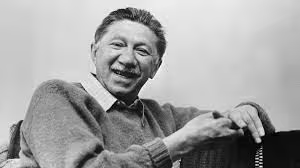
Abraham Harold Maslow (1 April 1908 – 8 June 1970) was an American psychologist who argued that psychology had studied the wrong half of human nature. The discipline of his day was organised around two programmes — Freudian psychoanalysis, which explained behaviour by unconscious conflict, and behaviourism, which explained it by reinforcement history — and both, Maslow thought, were built on the sick, the captive and the laboratory animal. What would psychology look like, he asked, if it began with the healthiest, most creative and most fulfilled people it could find?
The question produced humanistic psychology, which Maslow named and organised and which he called the "third force", and it produced the hierarchy of needs — the idea that human motives are arranged by strength, that the needs at the bottom dominate consciousness until they are reasonably satisfied, and that only then do the higher ones come forward. It is one of the handful of psychological ideas that has escaped the discipline entirely and entered ordinary talk, management training, marketing and education.
Two corrections are worth making at the outset, because both are usually got wrong. First, Maslow never drew the pyramid. The famous diagram was invented by management consultants — a stepped illustration by Keith Davis in 1957, then a triangle by Charles McDermid in a 1960 issue of Business Horizons — and it imposes a rigidity Maslow explicitly rejected. He wrote that a need does not have to be 100% satisfied before the next emerges, and described the hierarchy instead in terms of "decreasing percentages of satisfaction" as you go up. Second, late in his life Maslow concluded that self-actualization is not the automatic outcome of satisfying lower needs; he added a stage beyond it, transcendence, and became increasingly preoccupied with the people who fail to reach it.
In a 2002 survey published in the Review of General Psychology, Maslow was ranked the tenth most cited psychologist of the twentieth century.
Early Life and Education
Maslow was born in Brooklyn, New York, the eldest of seven children in a family of Jewish immigrants from Kyiv. His father, Samuel, was a barrel maker; his parents were uneducated and pushed him toward law. By his own account the childhood was miserable — he was the only Jewish boy in a non-Jewish neighbourhood, small, shy and, in his description, isolated to the point of pathology. Books were the refuge. He later wrote that he grew up in libraries "with hardly any friends", and that Jefferson and Lincoln, encountered in a school history book, were his heroes and later served as the prototypes in his studies of self-actualizing people.
He entered the City College of New York in 1926 to study law, transferred to Cornell, and then, in 1928, moved to the University of Wisconsin — the same year he married his first cousin Bertha Goodman, against his parents' wishes. He described the marriage and the transfer as the point at which his life began.
At Wisconsin he took his BA in 1930, his MA in 1931 and his PhD in 1934, working under Harry Harlow on primate behaviour. His dissertation examined dominance in the social behaviour of monkeys, and it produced a finding that prefigures everything he later argued: dominance among the animals he observed rested on something like self-confidence rather than on physical aggression. His exposure to behaviourism was thorough — he was trained in it, and worked as a Carnegie fellow under Edward Thorndike at Columbia — and his rejection of it was correspondingly informed.
What broke his commitment to behaviourism was his first child. He wrote that watching an infant made the extrapolation from animal learning to human life look "foolish", and that anyone who had raised a child could not be a behaviourist.
Academic and Professional Career
Brooklyn College and the European émigrés
Maslow taught at Brooklyn College from 1937 to 1951. The timing mattered enormously: these were the years when European psychologists fleeing Nazism arrived in New York, and Maslow sought them out. He learned Gestalt psychology from Max Wertheimer and Wolfgang Köhler, and psychoanalysis from Karen Horney, Alfred Adler and Erich Fromm. Wertheimer and the anthropologist Ruth Benedict became, in effect, his first research subjects — he took notes on them, deciding that the way to study psychological health was to study psychologically healthy people.
Fieldwork on the Blackfoot
In the summer of 1938 Maslow spent several weeks with the Blackfoot (Siksika) Nation in southern Alberta, observing and recording. The field notes, published decades later, show both genuine ethnographic curiosity and a readiness to read the Blackfoot as evidence for his emerging theory of human nature — he was struck by the near-absence of aggression and competitiveness in the community and concluded that destructiveness is not innate but a product of deprivation. The trip is often credited with turning him away from the assumption that human nature is essentially brute; it is also criticised, fairly, as romanticising.
A sharper version of that criticism has developed since, and it concerns attribution rather than romanticism. The claim that Blackfoot philosophy supplied the hierarchy — often popularised as a Blackfoot model drawn inverted beneath Maslow's pyramid — has been examined by Blackfoot scholars themselves, and their conclusions do not agree with each other. Roy Bear Chief, Peter Choate and Gale Lindstrom, working with an Elder knowledge keeper and drawing on Blackfoot oral history, argued in 2022 that Maslow's construct does not represent Blackfoot philosophy at all: a hierarchy of needs is not their worldview, self-actualisation is understood as present from birth rather than as the summit of a sequence, and the widely circulated story of a Blackfoot pyramid beneath Maslow's is, in their account, misleading. They also noted that Maslow's own writings do not support the claim that Blackfoot knowledge shaped the theory. A 2025 reading by Lawrence reaches a different conclusion, arguing that what Maslow encountered — a secure community whose learning was grounded in children, stories, ceremony, language, humour, land and connection — can legitimately be read as a basis for his later theories of need and self-actualisation.
What both sides accept is the baseline: Maslow visited Siksika, was struck by the near-absence of competition and the high level of self-regard he thought he observed, and retained an interest in what he saw. What they disagree about is how much influence to infer and how Indigenous knowledge should be represented. The disagreement is not settled, and it should be stated rather than resolved: it is not established that Blackfoot teaching supplied the hierarchy, and it is not established that it had no influence. One fact is not in dispute and is the part that carries the real charge — Maslow's 1943 paper and his 1954 book, the texts in which the hierarchy was published, do not mention the Blackfoot at all. Where the popular account asserts direct intellectual debt and the sceptical account asserts none, the documentary record shows a six-week fieldwork visit that went uncited in the works that made his reputation. In the decolonising literature on academic integrity the case is now standard, cited as an instance in which a written publication absorbed orally transmitted knowledge without attribution.
The hierarchy, humanistic psychology, and Brandeis
"A Theory of Human Motivation" appeared in Psychological Review in 1943. In 1951 Maslow moved to Brandeis University as the founding chair of its psychology department, where he stayed until 1969 and wrote Motivation and Personality (1954) and Toward a Psychology of Being (1962).
The institutional work happened in parallel. In 1961 Maslow co-founded the Journal of Humanistic Psychology with Anthony Sutich; and he was a founding member of the Association for Humanistic Psychology (its first president was James Bugental). He was elected president of the American Psychological Association for 1967–68, a striking fact given how far outside the methodological mainstream his work sat.
Management, eupsychia, and the last years
In the last decade of his life Maslow turned toward organisations. A 1962 visit to Non-Linear Systems, a Californian electronics firm run on unusually democratic lines, convinced him that the same principles applied to institutions, and produced Eupsychian Management (1965) — notes he had not intended to publish, and which later appeared as Maslow on Management. He coined eupsychia for the notional society composed of psychologically healthy people, and argued that the function of good management is to create the conditions under which people can actualise.
He was critical of what he saw as the passive, self-absorbed reading of self-actualization, and of the counterculture that had adopted him. He added transcendence above self-actualization — the motivation to serve something beyond the self — and wrote about the Jonah complex, the fear of one's own greatness that leads people to settle for less.
In 1969 he left Brandeis for the W. P. Laughlin Charitable Foundation in Menlo Park, California. He died of a heart attack there on 8 June 1970, at sixty-two.
Major Contributions to Psychology
The hierarchy of needs
Maslow proposed that human motives are ordered by prepotency — by how strongly they dominate the organism when unmet. The unsatisfied need, not the satisfied one, is what moves a person.
The five sets of basic needs, in his original 1943 formulation:
- Physiological — air, water, food, warmth, sleep, homeostasis, excretion. The most prepotent of all; a person chronically deprived here is, as Maslow put it, living by bread alone.
- Safety — security, stability, order, freedom from threat. Maslow noted that this need is most visible in children, who signal it openly, and in adults under conditions of breakdown.
- Love and belonging — the need for intimate relationships, family, a place in a group. Maslow held that its frustration is the most common source of maladjustment in affluent societies.
- Esteem — both the desire for strength, mastery and competence, and the desire for recognition from others. He argued that satisfaction of the first is more durable than satisfaction of the second.
- Self-actualization — the need to become what one is capable of becoming. Unlike the others, this need increases as it is satisfied.
Later he added cognitive needs (to know, to understand, to explore) and aesthetic needs (order, beauty, symmetry), and finally transcendence.
The crucial qualification is the one the pyramid erased. Maslow wrote that the hierarchy is not a staircase; several motives operate at once, and what shifts is which one dominates. He gave the example of a person whose physiological needs were 85% met, safety 70%, love 50%, esteem 40%, and self-actualization 10%. He also allowed for reversal: some people value esteem above love, and people routinely sacrifice safety — sometimes life — for ideals.
Deficiency needs and growth needs
Maslow split the hierarchy at the point where deprivation stops being the engine. Deficiency needs (D-needs) — the first four — arise from a lack and are quieted when met; their frustration produces anxiety and tension. Growth needs (B-needs, or metaneeds) are not deficits to be filled but capacities to be exercised, and satisfying them intensifies rather than reduces the motivation.
This distinction produces two different kinds of motivation. D-motivation is homeostatic: it aims at reducing tension. Metamotivation aims at growth, and Maslow described it as a state in which the person is not striving to remove a discomfort but pursuing truth, beauty, justice, playfulness or meaningfulness for their own sake.
B-cognition and B-values
Observing people in peak experiences, Maslow distinguished deficiency-cognition (D-cognition) — the ordinary, classifying, evaluating, need-driven way of perceiving — from being-cognition (B-cognition), which is holistic, non-judgemental, and attentive to the object as it is rather than as it is useful.
The values perceived in B-cognition he called B-values: truth, goodness, beauty, wholeness, aliveness, uniqueness, perfection, completion, justice, simplicity, richness, effortlessness, playfulness and self-sufficiency. Deprivation of these values, he argued, produces a specific kind of illness — not neurosis but boredom, apathy, and a sense that life has no point.
Peak experiences
A peak experience is a moment of unusual intensity in which a person feels whole, effortless and connected — moments of love, understanding, aesthetic absorption, or the completion of something difficult. Maslow's method was simply to ask people to describe their best moments, and the reports were consistent enough that he treated them as a class of event rather than a collection of anecdotes.
He was careful not to overstate the findings. Peak experiences are not confined to self-actualizing people, only more frequent among them; they cannot be willed; and their value depends on how they are integrated afterwards. Late in life he added plateau experiences — quieter, more sustained states of serene appreciation — which he considered more characteristic of genuine self-actualization than the dramatic peaks.
The study of self-actualizing people
Maslow's method was unusual and is the main reason his findings are hard to evaluate. He could not study self-actualization experimentally, so he studied exemplars: historical figures from which he inferred from biographies (Lincoln, Jefferson, Einstein, Eleanor Roosevelt, Jane Addams, William James, Spinoza, Walt Whitman) and a small number of living people he interviewed. From these he drew a profile — accurate perception of reality, acceptance, spontaneity, problem-centredness, autonomy, continued freshness of appreciation, democratic character, a sense of humour, creativeness, and resistance to enculturation.
The obvious objection is selection bias, and Maslow knew it: he chose the people who exemplified psychological health, then described what they had in common. What he produced is better read as a normative account of what human flourishing looks like than as a finding about how common it is. He estimated, famously and without much evidence, that perhaps one percent of the population reaches it.
Major Publications
- "A Theory of Human Motivation" (1943, Psychological Review) — the first statement of the hierarchy
- Motivation and Personality (1954) — the full exposition; the book that made the hierarchy standard
- New Knowledge in Human Values (1959) — the values conference papers
- Toward a Psychology of Being (1962) — B-cognition, metamotivation, and the critique of the "deficiency" model of psychology
- Religions, Values, and Peak-Experiences (1964) — peak experiences and their relation to religious experience
- Eupsychian Management (1965; republished as Maslow on Management, 1998) — humanistic principles applied to organisations
- The Psychology of Science: A Reconnaissance (1966) — an argument that science itself is motivated by needs and fears, and a call for a science that does not model itself on physics
- The Farther Reaches of Human Nature (1971, posthumous) — transcendence, the Jonah complex, and the later essays
Impact and Legacy
Maslow's legacy is unusually broad because it runs through two channels that barely intersect: academic positive psychology, and the enormous popular and commercial literature on motivation, leadership and self-improvement.
The academic line is real but indirect. Maslow used the phrase "positive psychology" in the title of a 1954 chapter, and when Martin Seligman made it the name of a research programme in 1998, he acknowledged the lineage. What survived the transfer was Maslow's question — what makes life go well, rather than what makes it go wrong — and not his answers; contemporary positive psychology tests claims empirically in a way Maslow did not.
The popular line is where the hierarchy is most used and most distorted. It is standard content in management training, marketing segmentation, education and product design, almost always in the pyramid form Maslow did not draw. The critique of that form is substantial: the pyramid suggests a sequence Maslow denied, and it pictures self-actualization as a rare elite attainment, which is precisely the reading that made it attractive to executives.
The empirical critique of the theory itself is straightforward. The ordering is not well supported. Louis Tay and Ed Diener's 2011 study across 123 countries found that the needs Maslow described are near-universally recognised and that their satisfaction predicts well-being, but that the sequence he proposed does not hold: people report pursuing social and esteem needs even when basic needs are unmet, and the pattern is closer to parallel than to serial. The cultural critique is related: the hierarchy places self-actualization — an individual achievement — above belonging, which looks less like a universal structure than like a mid-century American one. Douglas Kenrick and colleagues proposed a "renovated" pyramid grounded in evolutionary theory, reordering the levels by reproductive function and placing parenting above mate acquisition, which reverses Maslow's arrangement.
What survives is the part that is hardest to argue with: that deprivation and growth are different motivational states, that removing a person's deficits does not tell you what they will grow toward, and that psychology needs a vocabulary for the upper end of human functioning. Before Maslow it did not have one.
Associated Figures
- Harry Harlow — his doctoral supervisor at Wisconsin, and the source of his training in animal research
- Edward Thorndike — under whom he worked at Columbia; the behaviourism he rejected was learned at first hand
- Max Wertheimer and Wolfgang Köhler — the Gestalt psychologists who supplied the holism
- Karen Horney, Alfred Adler and Erich Fromm — the psychoanalytic dissenters whose work made a non-Freudian depth psychology conceivable
- Carl Rogers — the other principal architect of humanistic psychology, and the one who built an empirical research programme around it
- Martin Seligman — whose positive psychology takes up Maslow's question with different methods
Explore Your Needs Hierarchy
Discover where you are on the hierarchy of needs with our questionnaire:
Take the Maslow's Hierarchy of Needs Questionnaire →
Learn More
- The Hierarchy of Needs
- Self-Actualization
- What is Humanistic Psychology?
- Positive Psychology
- Meaning in Life
- History of Psychology
- Ross Stagner — who was measuring fascist attitudes years before the authoritarian-personality studies
- All Psychologists A–Z
References
- Maslow, A. H. (1943). A theory of human motivation. Psychological Review, 50(4), 370-396.
- Maslow, A. H. (1954). Motivation and Personality. Harper & Row.