Same Sea, Different Currents: Italy vs Greece in Cultural Psychology
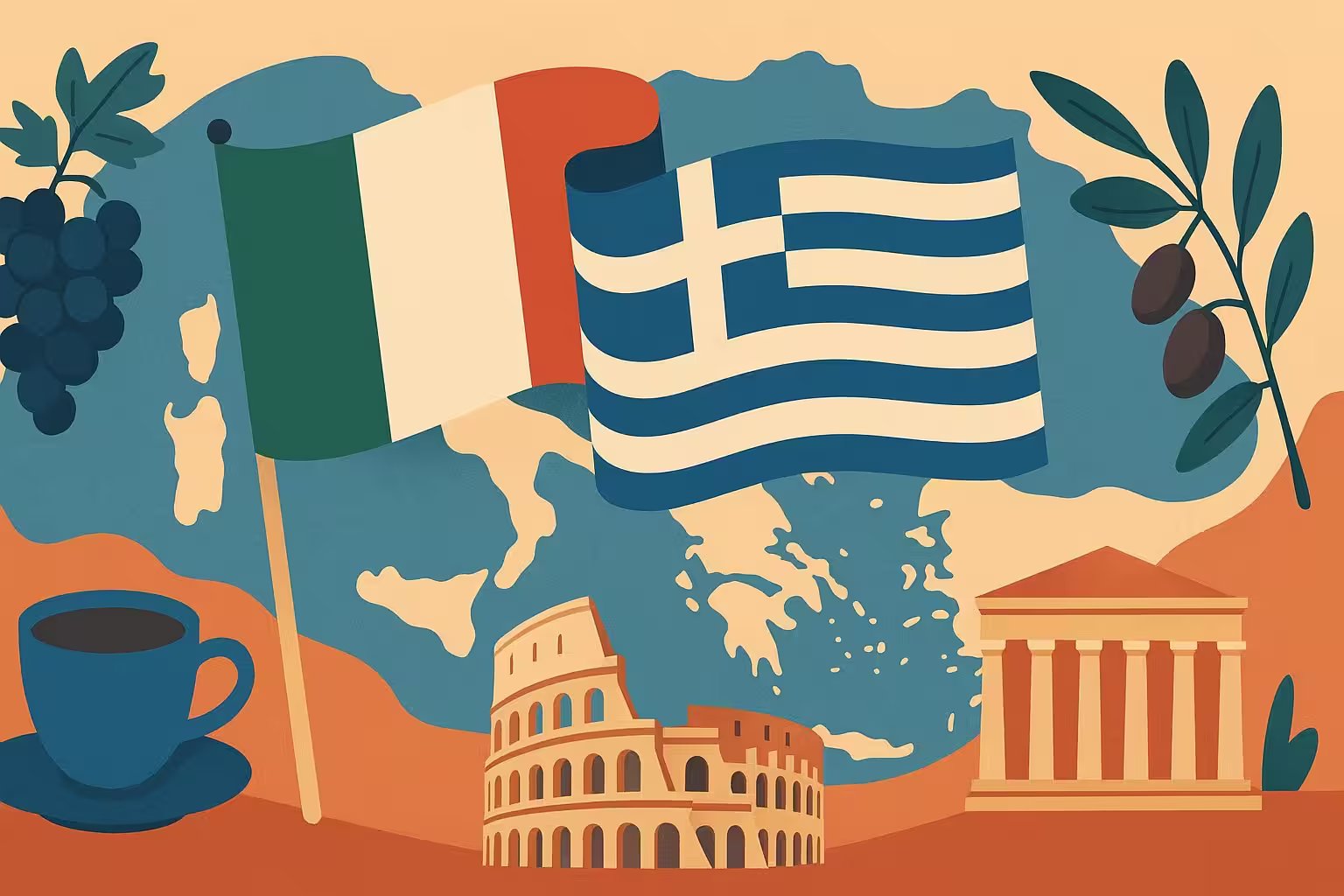
Summary – Same Sea, Different Currents
Italy and Greece share the warm waters, olive groves and convivial tables of the Mediterranean, yet their psychological profiles diverge in revealing ways.
Italian culture is marked by high verbal and gestural expressiveness, strong—but increasingly individualized—family ties, comparatively higher individualism and a pragmatic optimism that coexists with youth-employment anxiety.
Greek culture, while equally family-centred, is more collectivist, more uncertainty-averse, and famously steers life at a “siga-siga” (“slowly-slowly”) tempo that buffers stress but can also magnify the impact of macro-economic shocks.
Language structure, meal rituals and historical narratives all feed into these patterns, shaping how Italians and Greeks think, feel and act both at home and on the world stage.
Linguistic Landscape
Romance vs. Hellenic Roots
- Structure & Identity – Italian, a Romance language descended from Latin, encodes gender and formality but offers relatively flexible word order; Modern Greek, a branch of its own within the Indo-European family, retains a richer aspectual system and nominal cases. Both tongues are high-context in Hall’s sense, yet Italians rely more on co-speech gesture to add nuance.
- Expressive Codes – Italians regularly harness hand movements to foreground emotion and manage conversational turn-taking, a behaviour confirmed in laboratory comparisons with gesture-sparse Northern Europeans. Greeks gesture too, but communication often hinges on vocal prosody and culturally specific cues (e.g., the upward “yes” nod), reflecting a subtler kinesic palette.
Lifestyle Patterns
The Mediterranean Table
- Communal meals featuring olive-oil-rich dishes are central on both peninsulas; the UNESCO-listed Mediterranean diet frames eating as a social act that fosters belonging and subjective well-being.
- Psychological studies link adherence to this diet with higher life satisfaction and lower depressive symptoms across southern Europe.
Tempo & Time Orientation
- Italians cherish il dolce far niente—the sweet art of doing nothing—balanced by punctual coffee rituals that punctuate the workday.
- Greeks invoke “siga siga” to legitimate a slower, polychronic approach to time; tasks unfold sequentially but flexibly, prioritizing relationships over schedules.
Cultural-Psychological Dimensions
| Hofstede 6-D Model | Italy | Greece | Interpretation |
|---|---|---|---|
| Power Distance | ~50 | ~60 | Greeks accept slightly steeper hierarchies. |
| Individualism | 76 | 35 | Italy leans individualist; Greece collectivist. |
| Masculinity | 70 | 57 | Both value achievement, Italy somewhat more. |
| Uncertainty Avoidance | 75 | 100 | Greeks show Europe's highest rule orientation to buffer anxiety. |
| Long-Term Orientation | 61 | 45 | Italians plan further ahead. |
| Indulgence | 30 | 50 | Greeks score higher on leisure-seeking. |
*Data source: Hofstede Insights Country-Comparison Tool*.
Family & Social Structure
- Italy – Recent panel data show marked regional variation: northern provinces witness rising single-adult households, while the south preserves multigenerational living, yet overall coresidence rates are easing.
- Greece – The extended family remains the primary emotional and economic unit; even urban professionals maintain close daily contact with parents and siblings.
These differences moderate autonomy: young Italians may leave home earlier to study or work abroad, whereas Greek youths often remain embedded until marriage, reinforcing collectivist orientations.
Emotional Expression & Communication Style
- Italians rank among Europe’s most overtly expressive cultures—touch, volume and rapid turn shifts signal warmth and sincerity.
- Greek expressiveness is context-dependent: research finds Greeks decode negative group emotions quickly to police social norms, a competence linked to their high uncertainty avoidance.
Economic & Contemporary Pressures
- Greece – A decade-long debt crisis elevated national depression and anxiety rates; stigma around therapy is falling but resources remain scarce.
- Italy – Youth unemployment hovering near 20% fuels outward migration and feelings of “futurelessness,” though strong regional identities provide resilience.
Economic stress interacts with cultural dimensions: in Greece, rule-bound collectivism can amplify frustration when institutions falter; in Italy, individualistic coping (emigration, entrepreneurship) is more common.
Religious & Moral Frameworks
- Italy’s Roman Catholicism undergirds rituals from Sunday lunch to local patron-saint festivals, reinforcing regional pride and indulgence-tempering moral codes.
- Greek Orthodoxy shapes a calendar dense with fasting periods and saints’ days, fostering communal gatherings and prosocial norms such as philotimo (an ethic of honor and helping).
Practical Implications
| Context | Italians | Greeks | Tips |
|---|---|---|---|
| Negotiation | Expect expressive argument, flexible deadlines. | Expect detailed risk questions, need for consensus. | Pair facts with relational warmth. |
| Feedback | Direct yet wrapped in enthusiasm. | Indirect, framed to preserve group harmony. | Use empathy plus concrete solutions. |
| Teamwork | Value creativity & individual credit. | Value cohesion & role clarity. | Blend autonomy with clear rules. |
Conclusion
Language, lifestyle and cultural psychology weave distinct yet overlapping tapestries across the Italian and Greek experience.
Both peoples prize family, food and face-to-face interaction, but Italians externalize emotion through rapid-fire dialogue and personal agency, whereas Greeks navigate life’s uncertainties through collective resilience, ritual and a patient “siga siga” pace.
understanding these subtleties enables more authentic collaboration, richer travel experiences and culturally-tailored policy or business strategies.
More Cultural Comparisons
Explore how other pairs of cultures compare through the lens of psychology:
- Germans vs French: Cultural Psychology of Directness & Nuance
- Brazil vs Argentina: Cultural Psychology of Two Latin American Minds
- Danish vs Dutch: Cultural Psychologies of Hygge & Gezelligheid
- Related reading: social psychology — how groups, norms, and culture shape behavior
Important: This article is for informational and educational purposes only. It is not medical advice and not a substitute for professional diagnosis or treatment. If you are experiencing mental health difficulties, please consult a qualified healthcare professional. If you are in crisis, contact your local emergency services or a crisis helpline immediately.