Simone de Beauvoir: French Women & Feminists in History
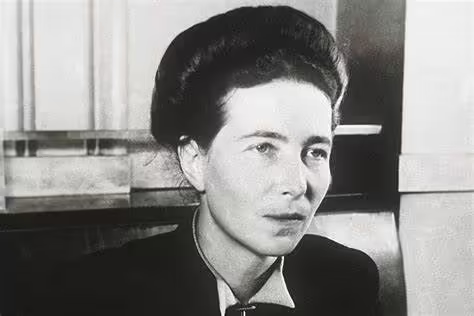
Simone de Beauvoir (born January 9, 1908, Paris, France—died April 14, 1986, Paris) was a French writer and feminist, a member of the intellectual fellowship of philosopher-writers who have given a literary transcription to the themes of existentialism. She is known primarily for her treatise Le Deuxième Sexe, 2 vol. (1949; The Second Sex), a scholarly and passionate plea for the abolition of what she called the myth of the "eternal feminine." It became a classic of feminist literature.
Working alongside other famous existentialists such as Jean-Paul Sartre, Albert Camus and Maurice Merleau-Ponty, de Beauvoir produced a rich corpus of writings including works on ethics, feminism, fiction, autobiography, and politics.
1 Life
Simone de Beauvoir was born on January 9, 1908 in Paris, France. She completed her early education at Lycée Fénelon, and in 1925, moved on to the Institut Catholique de Paris to study mathematics, and the institut Sainte-Marie for literature and languages. Following the completion of her degree in 1928, de Beauvoir studied philosophy at the Sorbonne and wrote her MA thesis on Leibniz.
In her early career, de Beauvoir worked primarily as a writer, but also as a secondary school teacher to support herself financially. However, she was dismissed multiple times from teaching positions for teaching about feminism, or for ‘morally corrupting’ the youth. De Beauvoir published her first novel, She Came to Stay, in 1943, followed by The Blood of Others. In 1944 de Beauvoir published her first piece in the field of philosophy on existentialist ethics.
De Beauvoir is best known for her book, The Second Sex, published in 1949. The book was published in two volumes, Facts and Myths and Lived Experience, and focused on feminism and sexuality. The publication of The Second Sex is considered to be the beginning of the second wave of feminism.
Interestingly, de Beauvoir's The Second Sex was placed on the Vatican's Index Librorum Prohibitorum (List of Prohibited Books) following its translation and mass publication; the Index itself was abolished in 1966.
2 Feminism
The Second Sex
Simone de Beauvoir was known for many pieces of writing and ideas, particularly in the realm of feminism. Perhaps her most innovative and long-lasting ideas were outlined in her publications including The Second Sex and the Manifesto of the 343.
In The Second Sex, de Beauvoir analyzed women's oppression and outlined the foundation for contemporary feminism. The Second Sex is a 1000-page critique of the patriarchal society, and the idea that women were considered to be lesser beings than men. De Beauvoir famously writes, "One is not born a woman, but becomes one," suggesting that gender is a societal construct, not a biological identifier.
Throughout The Second Sex, de Beauvoir references ancient creation myths and the Bible, arguing that women are labeled as the Other, and thought to be secondary to men. In these biblical myths, women are frequently portrayed as the sinful or weak side of a being. Using evidence from the literature, de Beauvoir writes a compelling argument as to the connection between myth and history. Through this connection, she argues, men defined women as the Other, the darker, inferior side of humanity, unworthy of responsibility.
In The Second Sex, de Beauvoir also outlines women's difficulties in liberating themselves, economically, politically and sexually. The ideas and arguments de Beauvoir outlined in her writing were revolutionary at the time, and sparked an awakening of a second wave of feminism.
The Manifesto of the 343
She wrote and signed the Manifesto of the 343, published on April 5th, 1971, in which she encouraged 342 other women who experienced issues with access to birth control or reproductive rights to sign as well. In this petition, de Beauvoir demanded access to contraception and the freedom to abortion. She writes, "I will have a child if I want one, and no moral pressure, institution or economic imperative will compel me to do so." The Manifesto paved the way for legal and safe birth control and abortions in France.
3 Books by Simone de Beauvoir
Manifesto of the 343: This is the translated version of Simone de Beauvoir's Manifesto. It was signed by 343 women in France, and paved the way for women’s rights to birth control, as well as abortion.
She Came to Stay (1943): De Beauvoir's first novel, set in Paris during the Second World War. The novel follows Françoise and Pierre, who are in an open relationship. This novel is generally believed to be an extension of de Beauvoir's own experiences, and reflective of her own views on marriage.
The Mandarins (1954): In this book, the personal lives of a close-knit group of French intellectuals are explored. The novel is set in post-World War II France, and the characters must overcome a number of challenges in order to establish themselves in post-war Europe. De Beauvoir won France’s most prestigious literary prize, the Prix Goncourt, for this novel.
The Ethics of Ambiguity (1947): This essay is a product of a lecture de Beauvoir gave in 1945, wherein she challenged the ability of Sartre’s Being and Nothingness to support an ethical system. In this essay, she outlines her stance on ethics and examines the true nature of free will in the world.
The Second Sex (1949): In this book, de Beauvoir examines women's place in society as Other, and argues that as long as this continues women will continue to be repressed. Further, she outlines a distinction between sex and gender. The publication of this book is thought to have sparked the beginning of second wave feminism, and is a cornerstone of 20th century feminist philosophy.
Memoirs of a Dutiful Daughter (1958): In de Beauvoir's autobiography, she brings her childhood and family dynamics to light. In this book, de Beauvoir’s tenacity and rebellious nature are obvious, and seem to be foretelling of the strong and forward-thinking woman she becomes.
Adieux: A Farewell to Sartre (1981): This is a biographical work by de Beauvoir focusing on the final decade of philosopher Sartre’s life, whom she was in a relationship with. She provides a historical account of his life and insight into their conversations and varying perspectives as a couple.
Learn More
- Learn More About Women's Rights
- Learn More About Feminism
- Learn More About Feminist Psychology
- Learn More About History of Psychology
- Learn More About Psychology Research
- Learn More About Positive Psychology
- Learn More About Lifestyle with Positive Psychology
- All Psychologists — browse the full biographical collection.
References
- de Beauvoir, S. (1949). Le Deuxième Sexe. Gallimard.