Optical Illusions: When Seeing Isn't Believing
An optical illusion occurs when our visual system and brain processes lead us to perceive something differently from objective reality.
By exploiting the shortcuts and assumptions of our perceptual machinery, illusions reveal how the brain interprets color, shape, motion, depth, and context. This topic is related to Gestalt principles and cognitive psychology.

Table of Contents
- What Is an Optical Illusion?
- Categories of Illusions
- Key Mechanisms & Gestalt Principles
- Classic Examples
- Neuroscience Behind the Tricks
- Applications & Insights
- The Fascinating Phenomenon of the Old Woman Young Woman Illusion
- History
- Science
- Perception
- Importance
- A Final Word
- Who Did You See First?
- Historical Perspectives
- Psychology’s Optical Illusion Research Pioneers
- Joseph Jastrow
- Edgar Rubin
- Edwin Boring
- Fifty Shades of Gray (Minus 49!)
- Key Takeaways
- Further Reading
What Is an Optical Illusion?
An optical illusion is a visually perceived image that differs from objective reality in appearance, interpretation, or measurement.
Illusions arise because the visual system actively constructs our perception—using context, prior experience, and neural processing to make sense of ambiguous or limited sensory input.
Categories of Illusions
| Type | Description | Example |
|---|---|---|
| Literal | Image differs from reality in shape or size | Café wall illusion |
| Physiological | Overstimulation of eyes or brain (brightness, color) | Afterimages, Hermann grid |
| Cognitive | Higher-level interpretation—misleading context or cues | Müller-Lyer, Kanizsa triangle |
Key Mechanisms & Gestalt Principles
- Figure–Ground Segregation: Brain assigns parts of scene as object vs. background (Rubin vase).
- Grouping by Similarity, Proximity, Continuity: Causes us to see shapes or patterns that aren’t there.
- Contrast and Assimilation: Surrounding luminance or color shifts perception of a target.
- Depth Cues & Perspective: Converging lines, shading, relative size create illusory depth (Ponzo illusion).
Classic Examples
- Müller-Lyer Illusion: Equal-length lines appear different due to arrowhead contexts.
- Café Wall Illusion: Parallel horizontal lines seem sloped because of staggered black-and-white “bricks.”
- Kanizsa Triangle: Implied contours lead us to see a bright, white triangle that isn’t drawn.
- Motion Aftereffect (“Waterfall”): After staring at motion, a stationary scene seems to move oppositely.
- Ames Room: A distorted room makes people appear to grow or shrink when crossing it.
Neuroscience Behind the Tricks
- Lateral Inhibition: Retinal cells inhibit neighbors, exaggerating edges and brightness borders.
- Predictive Coding: Cortex generates expectations and fills in missing information, sometimes inaccurately.
- Receptive Field Organization: Neurons tuned to orientation, motion, spatial frequency feed higher-level areas that interpret patterns.
- Multilevel Processing: From V1 edge detectors to inferotemporal shape modules—illusions can arise at multiple stages.
Applications & Insights
- Art and Design: Artists exploit perceptual quirks (Op Art, trompe-l’œil).
- Vision Research: Illusions test models of visual processing and diagnose disorders.
- Multisensory Perception: The McGurk Effect shows how vision can override hearing.
- Virtual Reality & UI: understanding illusions improves realistic rendering and reduces discomfort.
- Education: Demonstrations engage learners in cognitive science and neuroscience.
Fifty Shades of Gray (Minus 49!)
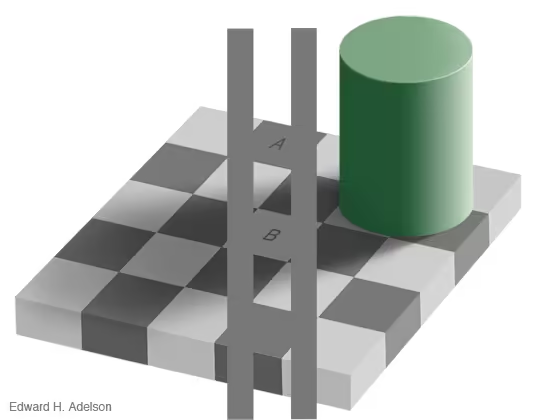
Created by Edward H. Adelson (MIT), this illusion shows that squares A and B are the same shade of gray. Your brain compensates for perceived shadows—demonstrating how our visual system infers real-world lighting conditions to inform perception.

Historical Perspectives
“The physiology of the eye originated much of the psychology of sight... For the various other phenomena, such as those of the optical illusions, of monocular and of binocular space, we have at present no hope of anything beyond a psychological knowledge...”
– E.W. Scripture (1897), Sources of The New Psychology
This extract underscores how, even at the turn of the 20th century, optical illusions were recognized as a bridge between physiological optics and psychological theory.
Psychology’s Optical Illusion Research Pioneers
Joseph Jastrow (1863–1944)
Joseph Jastrow, one of the first APA presidents, published “A Study of Zöllner's Figures and Other Related Illusions” in The American Journal of Psychology (1892). He demonstrated how line contrasts influence size judgments—the basis of the Jastrow Illusion.
Among his renowned academic interests, Jastrow was noted for his work on optical illusions. His landmark paper on the subject 'A Study of Zöllner's Figures and Other Related Illusions' was published in 'The American Journal of Psychology' in April 1892, which included the following extract and illustrations:
We may also be tempted to judge of two areas by their juxtaposed lines, thus regarding one of two equal areas as larger than the other. This is shown (in the figure below) which also shows very well when the figures are cut out and moved about to assume various positions. The upper figure seems larger, because its long side is brought into contrast with the shorter side of the other figure. Similarly, a square resting on a corner seems larger than one resting on a side, because we then contrast the diagonal with the side.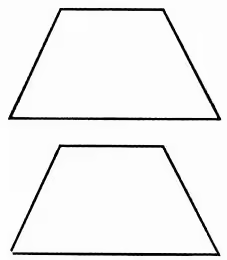
(The next figure) presents another illustration of the same principles; the lower figure seems to be distinctly the larger, and the contrast is emphasized because it is thrown entirely to one side of the figure. In judging areas, we cannot avoid taking into account the lengths of the lines by which the areas are limited, and a contrast in the lengths of these is carried over to the comparison of the areas. We judge relatively even when we most desire to judge absolutely. Relative distinctions and the perception of relation seem to be more natural and significant than absolute ones. We cannot view the part as unrelated to the whole. This is a widely applicable principle and is suggested as a convenient guiding principle by which the study of such illusions of sense may be profitably directed.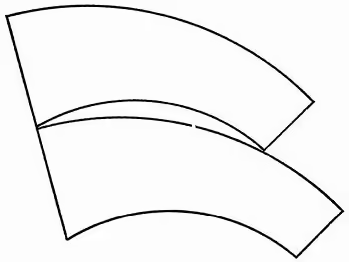
Joseph Jastrow was instrumental in popularizing psychological science among the general public and regularly wrote for leading magazines such as Popular Science Monthly, including an article in 1899 titled 'The mind's eye' which featured the rabbit–duck illusion shown at the top of the page.
Edgar Rubin (1886–1951)
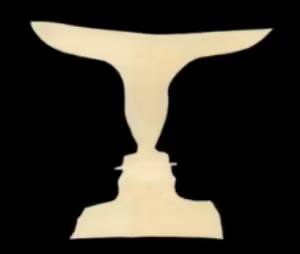
Rubin introduced the Vase/Two Faces figure in his 1915 dissertation, pioneering research on figure–ground organization that became foundational for Gestalt psychology.
Edwin Boring (1886–1968)
A Harvard experimentalist and historian, Boring popularized the Old Woman Young Woman ambiguous illusion in 1930, highlighting its role in studying ambiguous figures and perception.
Who Did You See First?

The Fascinating Phenomenon of the Old Woman Young Woman Illusion
The Old Woman Young Woman illusion is a perceptual phenomenon that has captivated audiences for generations. It's a classic optical illusion which, depending on your personal perspective, consists of the image of a young or elderly woman.
The History of the Old Woman Young Woman Illusion
The famous illusion first appeared on a German postcard in 1888. Its enduring popularity was instigated by British cartoonist William Ely Hill, who adapted and published it under the title "My Wife and My Mother-in-Law" in Puck magazine in 1915. Later, Professor Edwin Boring included the figure in an article for the American Journal of Psychology (1930), cementing its place in perception research.
The Science of the Old Woman Young Woman Illusion
Optical illusions exploit the brain's tendency to fill in gaps and complete patterns, leading to ambiguous interpretations. Here, "top-down processing" plays a key role: prior knowledge about aging and facial features biases what we see first. A 2018 study at Flinders University found that viewers aged 18–30 tended to see the young woman first, while those over 30 initially perceived the older woman—demonstrating an own-age bias in face perception.
The Perception of the Old Woman Young Woman Illusion
Our brains automatically make assumptions based on prior experiences. If you associate the contours with an elderly face, that figure emerges; if primed to look for youth, the younger woman appears. This rapid perceptual shift highlights our cognitive flexibility and how context can override raw sensory data.
the importance of the Old Woman Young Woman Illusion
- Power of Perception: Shows how personal history and beliefs shape reality.
- Cognitive Complexity: Reveals multi-stage processing—from retina to cortex to conceptual systems.
- Context Effects: Demonstrates how framing and instructions alter what we see.
- Educational Tool: Engaging way to teach perception, ambiguity, and bias.
Key Takeaways
- Constructive Vision: Perception is an inference, not a direct snapshot.
- Multiple Levels: Illusions arise from retinal, cortical, and cognitive processes.
- Gestalt & Context: Principles like figure–ground and contrast drive many classic illusions.
- Broad Impact: From art and education to VR and diagnostics, illusions inform a wide range of fields.
Further Reading
- Gregory, R. L. (1997). Eye and Brain: The Psychology of Seeing.
- Eagleman, D. (2001). Visual Illusions and Neurobiology.
- Wilder, J., Freund, I., & Eagleman, D. (2015). “Visual adaptation and face perception.” Current Biology.
- Ramachandran, V. S., & Hirstein, W. (1999). “Three laws of qualia.” Journal of Consciousness Studies.
Try it Now
Explore Optical Illusions on kuakua.app
References
- Gregory, R. L. (1968). Perceptual illusions and brain models. Proceedings of the Royal Society of London B, 171(1024), 279-296.