Memory Palace Technique: Building Mental Architecture for Long-Term Recall
A memory palace (or method of loci) asks you to map ideas onto locations in a familiar space—then "walk" the route in your mind to retrieve them. Rooted in ancient Greek and Roman rhetoric, the technique remains one of the most powerful, research-backed mnemonics available: laboratory novices can triple recall after just a few sessions, and MRI studies show it reshapes hippocampal-parietal networks toward patterns seen in elite memory athletes. This technique is related to learning strategies and cognitive psychology.
Table of Contents
- Origins & Historical Milestones
- How It Works in the Brain
- Step-by-Step Construction Guide
- Modern Variations & VR Palaces
- Evidence for Effectiveness
- Applications
- Common Pitfalls & Fixes
- Key Takeaways
- Further Reading
Origins & Historical Milestones
- Ancient Greece (5th c. BCE): Simonides of Ceos reputedly invented the method after a banquet-hall collapse, linking each guest to their seat.
- Roman Rhetorica: Rhetorica ad Herennium and Cicero’s De Oratore formalized loci for speech memorization.
- Middle Ages → Renaissance: Scholastics used vast “memory cathedrals” to organize theology.
- Modern Era: Popularized by Joshua Foer’s Moonwalking with Einstein and competitive memory circuits.
How It Works in the Brain
Functional-MRI shows that navigating a memory palace co-activates the hippocampus, parahippocampal gyrus, retrosplenial cortex, and posterior parietal areas—regions for spatial mapping and episodic binding.
Training novices for six weeks induces resting-state connectivity shifts toward the patterns of world memory champions.
Vivid, bizarre images are thought to be more memorable and thus to bind more strongly to their loci, making route-based retrieval more reliable.
Step-by-Step Construction Guide
1. Select a Familiar Structure
Pick a well-known route (childhood home, campus loop). Stability trumps size at first.
2. Define Sequential “Loci”
List 10-20 discrete stopping points (door, sofa, fridge). Stick to a consistent direction to avoid path confusion.
3. Encode Items with Vivid Imagery
Transform each fact into a sensory-rich, exaggerated scene interacting with the locus (e.g., Newton juggling apples in the hallway for “gravity”).
4. Mentally Walk & Rehearse
Traverse the palace slowly, reinforcing routes with spaced retrieval sessions.
5. Expand or Nest Palaces
When loci fill up, create new rooms, floors, or entirely new routes; advanced users build themed districts.
Modern Variations & VR Palaces
Virtual-reality platforms let learners physically walk digital palaces, boosting immersion and recall by ~10–15% over desktop imagery in early trials.
Mobile apps now pair GPS routes with spaced-repetition reminders, turning daily commutes into live memory journeys.
Evidence for Effectiveness
| Study | Sample | Result |
|---|---|---|
| Dresler et al. (2017) fMRI study | 23 memory athletes vs. matched controls | Athletes out-recalled controls on word learning; novices reached near-athlete recall after 6 weeks of loci-method training. |
| Medical-student RCT (2014) | 78 anatomy learners | Loci group scored 15% higher on retention after 1 month. |
| VR Method of Loci (2022) | 11 participants | Optimized VR palace beat 2-D flashcards by 12% on word list recall. |
Meta-analyses confirm medium-to-large effect sizes across vocab, numbers, and abstract facts.
Applications
- Language Vocabulary: Assign nouns to kitchen items, verb conjugations to bedrooms.
- Speech & Debate: Anchor key arguments along a podium-to-exit route for seamless recall.
- Exam Prep: Encode formulas in a campus walk; combine with spaced testing for STEM subjects.
- Rehabilitation: Spatial mnemonics aid memory-impaired patients in daily task sequences.
Practice Cases: How to Train Your Memory Palace
The following exercises offer concrete ways to apply the Memory Palace technique, especially useful for learners and educators looking to build strong spatial-memory associations.
🧠 Case 1: The Two-Part Recall Challenge
Goal: Compare recall ability with and without a Memory Palace.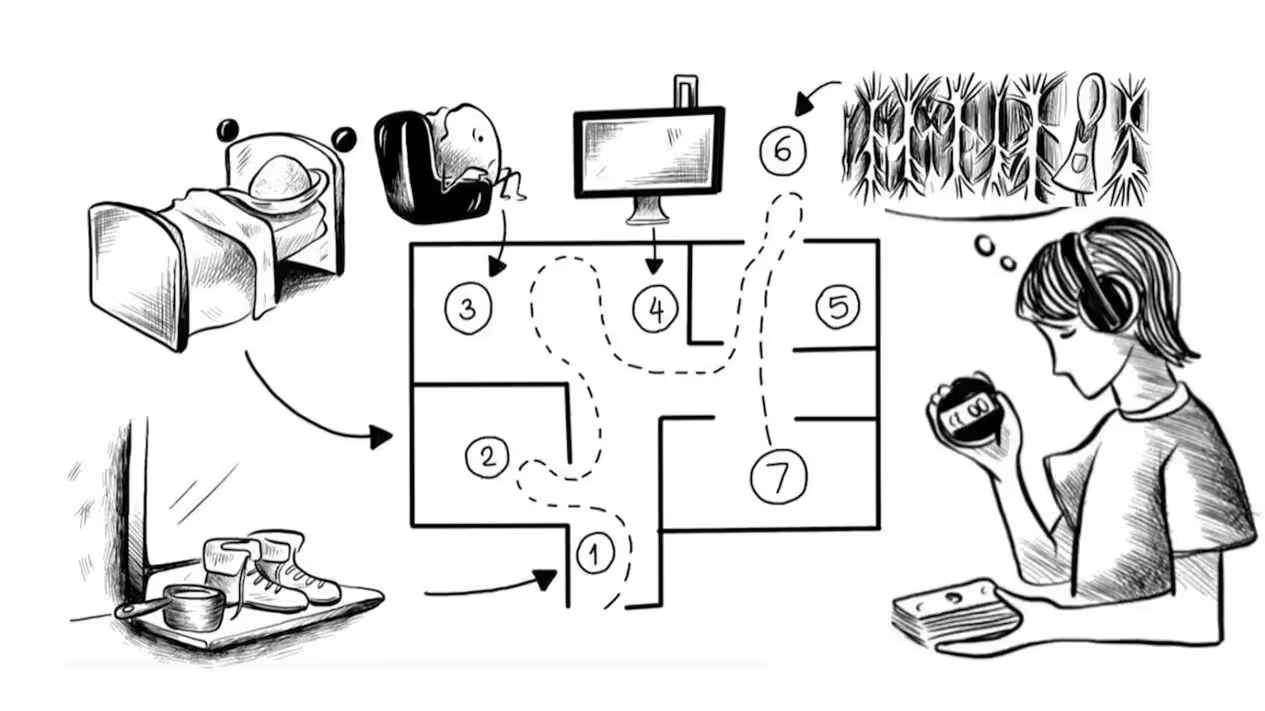
Steps:
Without Palace:
- Memorize the following 10 words in 45 seconds:
Apple, Laptop, George Bush, Sock, Twenty, Guitar, Charles the Great, Bacon, Haircut, River - Count backwards from 15.
- Write down as many words as you can remember.
- Memorize the following 10 words in 45 seconds:
With Memory Palace:
Visualize a familiar route (e.g., your home or daily path).
Walk through it mentally, identifying vivid spots in each room (e.g., green spoon on the table).
Link each new word to a location with a strange story. For example:
Imagine Charles the Great frying bacon in your kitchen while getting a haircut under a river of apples.
Count backward from 15 and write the recalled words.
📌 Expected Result: Most users recall more items using the Palace method.
🧸 Case 2: Memory Palace for Children
Goal: Teach young learners how to build a memory palace.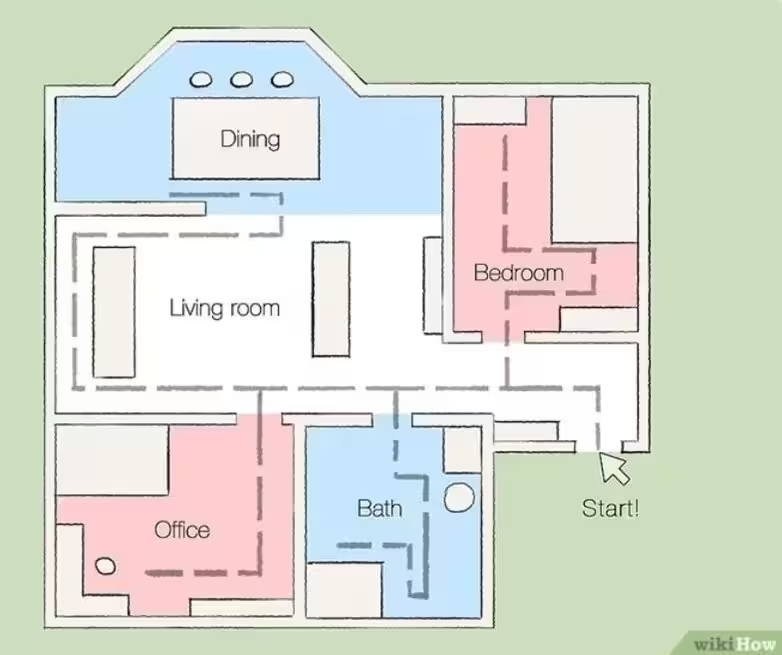
Materials:
- Two word lists (10 items each)
- Pencils
- Stickers as rewards
Activity Flow:
- Give children 10 words to memorize without any aid.
- Then teach them to imagine their house and assign a word to each room or object (e.g., a lion sleeping in the sink).
- Have them walk through their imaginary route and recall all words.
- Reward success with stickers to reinforce fun and engagement.
🤯 Case 3: Bizarre Story Anchoring
Goal: Strengthen encoding by mixing absurdity and sensory detail.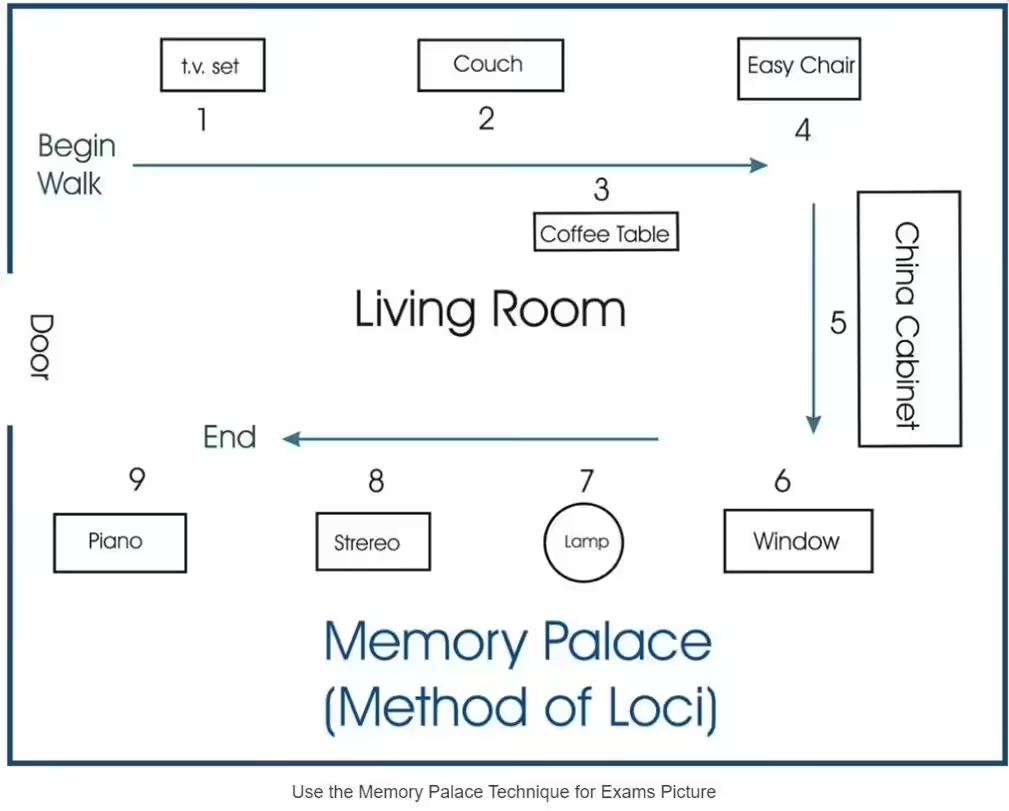
Example Flow:
- Use a familiar place like your route to a friend’s house.
- Take the word
Cucumberand imagine it as a green wizard casting spells in your fridge. - Picture
Harry Stylesriding a balloon above your TV, while ahammersings opera in the bathroom.
💡 Tip: The weirder the story, the better the memory hook.
Common Pitfalls & Fixes
| Pitfall | Quick Fix | Source |
|---|---|---|
| Palace Overcrowding | Cap 1–2 items per locus; open a new wing. | |
| Bland Imagery | Use emotion, exaggeration, multisensory cues. | |
| Route Confusion | Sketch a floor plan; rehearse forward & reverse. | |
| Interference Between Palaces | Separate themes (e.g., biology vs. law) and entry cues. |
Key Takeaways
- A memory palace leverages spatial-episodic networks to bind vivid images to familiar loci, drastically enhancing recall.
- Neural evidence shows hippocampal-parietal remapping after just weeks of practice, resembling elite memory athletes.
- Stepwise construction—choose a space, set loci, encode vivid scenes, rehearse—yields robust, scalable palaces.
- Modern VR and mobile tools expand accessibility, while evidence supports applications from language learning to medical education.
- Manage pitfalls (overcrowding, bland images) with deliberate design and spaced retrieval for lifelong cognitive benefit.
Further Reading
- Wikipedia overview of the Method of Loci for history and variations.
- “Mnemonic Training Reshapes Brain Networks” – Neuron study on memory athletes.
- Smithsonian Magazine piece on trainable memory champion brains.
- Art of Memory tutorials on palace construction and language learning.
- Stanford Medicine news on memorization tool bulking brain connections.
- VR loci study (2022) in Frontiers in Psychology.
- Verywell Health primer on Method of Loci for everyday users.
- TIME article summarizing four memory-palace steps.
References
- Yates, F. A. (1966). The Art of Memory. Routledge & Kegan Paul.