E. O. Wilson
Introduction
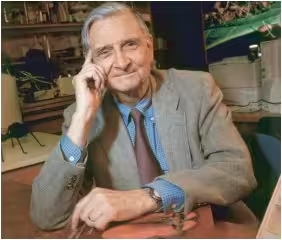
Edward Osborne Wilson (June 10, 1929 – December 26, 2021) was an American biologist, not a psychologist by training or by profession. He is a fixture in psychology reference works all the same, because a single chapter of a single book changed how the discipline talks about human nature. Wilson was a myrmecologist, the leading authority of his era on ants, and he spent essentially his whole working life at Harvard University. In 1975 he published Sociobiology: The New Synthesis, whose final chapter extended the evolutionary analysis of social behavior to Homo sapiens, arguing that traits such as male aggression, xenophobia, the sexual division of labor and even moral rules had been shaped by natural selection. The claim set off one of the bitterest scientific disputes of the twentieth century, and its descendants, including evolutionary psychology and gene-culture coevolution, remain part of psychology's landscape. Wilson also co-founded island biogeography theory with Robert MacArthur, popularized the biophilia hypothesis, and became one of the most recognizable advocates for biodiversity conservation.
Early Life and Education
Wilson was born in Birmingham, Alabama, the only child of Inez Linnette Freeman and Edward Osborne Wilson Sr. His father was an alcoholic who eventually died by suicide; his parents divorced when the boy was seven. He grew up across a string of Southern towns, including Mobile, Decatur and Pensacola, spending every free hour outdoors, and earned the Eagle Scout award while serving as nature director at his Boy Scout summer camp.
Two accidents narrowed his options and, in his own account, gave him his vocation. In the same year his parents divorced, a fishing accident destroyed the sight in his right eye; a cataract formed and the lens was surgically removed. Partial deafness followed during adolescence. Birds and mammals, which must be watched at distance and identified by ear, were effectively closed to him. Insects could be held inches from his good eye, and with 20/10 vision in that eye he could make out the hairs on their bodies. He later wrote that he noticed butterflies and ants more than other children did, and took an interest in them automatically.
At eighteen, intent on entomology, Wilson began by collecting flies, but a wartime shortage of insect pins pushed him toward ants, which could simply be stored in vials. Encouraged by the myrmecologist Marion R. Smith of the National Museum of Natural History, he surveyed the ants of Alabama and reported the first colony of imported fire ants in the United States, near the port of Mobile. He earned a B.S. in 1949 and an M.S. in 1950 at the University of Alabama, then moved to Harvard, where he completed a doctorate in biology in 1955 with a monographic revision of the ant genus Lasius.
Academic and Professional Career
Wilson joined the Harvard faculty in 1956 and stayed for more than four decades. He worked first in the biology and zoology departments, served as curator in entomology at the Museum of Comparative Zoology from 1973 to 1997, and held a succession of named chairs, including the Frank B. Baird Professorship of Science and, from 1994, the Pellegrino University Professorship. He retired as professor emeritus in 1997 and remained active as a writer and public figure until his death.
His early research was taxonomy and ecology rather than theory of mind. With William L. Brown he defined character displacement, the process by which two closely related species diverge rapidly where their ranges overlap, reducing both competition and hybridization. He established that ants communicate largely through chemical pheromones, and while revising the ants of the South Pacific he formulated the taxon cycle, linking speciation and dispersal to the habitats a population encounters as it expands. In 1963 he and MacArthur published the equilibrium theory of island biogeography, which predicted species richness from immigration and extinction rates, and in 1967 the two men expanded it into a book that became a cornerstone of conservation biology.
The Insect Societies (1971) synthesized the ecology, population dynamics and social behavior of thousands of species of ants, bees, wasps and termites. It was the prelude to Sociobiology: The New Synthesis (1975), which attempted nothing less than a general theory of social behavior across all species, closing with 27 pages on humans. On Human Nature (1978) developed the human argument and won Wilson the first of two Pulitzer Prizes for General Nonfiction; the second came in 1991 for The Ants, written with Bert Hölldobler. Over the following decades he turned increasingly to conservation and to large synthetic arguments about knowledge itself, publishing Biophilia (1984), The Diversity of Life (1992), Consilience: The Unity of Knowledge (1998), The Future of Life (2002), The Creation (2006), The Social Conquest of Earth (2012) and Half-Earth (2016), which proposed reserving half the planet's surface for other species. He died in Burlington, Massachusetts, on December 26, 2021, at the age of 92.
Major Contributions to Psychology
Sociobiology and the biological study of social behavior
Wilson defined sociobiology as the systematic study of the biological basis of all social behavior. Its central claim was that social organization, from the caste system of a termite colony to the mating systems of primates, is a product of evolution and can be analyzed with population genetics and ecology rather than treated as a separate domain of culture or learning. For psychology the shock was the extension of this logic to our own species. Wilson argued that human social behavior is not infinitely malleable, that universal patterns such as incest avoidance, male coalitionary aggression and the sexual division of labor are best explained as evolved predispositions rather than as products of arbitrary convention. He consistently denied that this amounted to determinism, estimating that perhaps ten percent of human behavior was directly genetic in origin, and he insisted that knowing a predisposition exists is the precondition for deciding whether to encourage or suppress it.
Altruism, kin selection and eusociality
Darwin had called the sterile worker ant the most serious special difficulty for his theory. Following W. D. Hamilton, Wilson treated altruism as a puzzle solvable by kin selection: an organism can advance its genes by helping relatives, because the unit of evolutionary accounting is the gene rather than the individual. Wilson's own contribution was to make eusociality, with its reproductive and non-reproductive castes, the empirical centerpiece of the problem. He documented how rare eusociality is, how few times it has arisen, and how ecologically dominant the lineages that achieved it became.
Island biogeography, biophilia and the psychology of nature
Wilson's biogeographic work supplied the quantitative framework that conservation biology still uses to predict how habitat loss and fragmentation translate into extinctions. He also argued that human beings possess an innate affinity for living systems, which he called biophilia, and that the erosion of contact with nature carries psychological as well as material costs. This claim, though influential in environmental and conservation psychology, has proved difficult to test directly and is often criticized as more poetic than empirical.
Consilience and the unity of the behavioral sciences
In Consilience, Wilson argued that the fragmentation of knowledge into separate disciplines is a historical accident, and that the social sciences and humanities would in time be linked to the natural sciences through causal explanation. For psychology this meant that the study of mind should be continuous with evolutionary biology and neuroscience. Critics in the humanities replied that explanation in the human sciences is interpretive rather than lawlike, and that Wilson's program had more in common with nineteenth-century positivism than with the practice of either history or cultural anthropology.
From kin selection to multilevel selection
The most consequential reversal of Wilson's later career concerned his own mechanism. By the mid-2000s he had concluded that inclusive fitness theory explained less than he had once believed, and in 2010 he published with the mathematical biologists Martin Nowak and Corina Tarnita a paper in Nature arguing that standard natural selection in structured populations, not kin selection, gives the simpler and more general account of eusociality. Selection, they argued, acts simultaneously at several levels: selfish individuals outcompete altruistic ones within groups, while groups of altruists outcompete groups of selfish individuals. This was the framework later described as multilevel selection, and it was taken up in the social sciences by researchers such as Jonathan Haidt, who argued that human moral psychology bears the signature of selection between groups as well as within them.
Major Publications
- The Theory of Island Biogeography (1967), with Robert H. MacArthur
- The Insect Societies (1971)
- Sociobiology: The New Synthesis (1975)
- On Human Nature (1978)
- Biophilia (1984)
- The Ants (1990), with Bert Hölldobler
- The Diversity of Life (1992)
- Consilience: The Unity of Knowledge (1998)
- The Social Conquest of Earth (2012)
- Half-Earth: Our Planet's Fight for Life (2016)
Impact and Legacy
Wilson's honors include two Pulitzer Prizes, the Crafoord Prize of the Royal Swedish Academy of Sciences in 1990, the Tyler Prize for Environmental Achievement, the King Faisal Prize, the Kistler Prize, the BBVA Foundation Frontiers of Knowledge Award in Ecology and Conservation Biology, and the U.S. National Medal of Science, whose year is given variously as 1976 and 1977 in different sources. His influence on psychology runs through the fields that sociobiology spawned: evolutionary psychology, human behavioral ecology, and the study of the evolved foundations of morality and cooperation. Institutions he helped build, including the Encyclopedia of Life and the Half-Earth Project, continue his conservation work.
The controversy, however, has never fully settled. In November 1975 a group of Boston-area scientists and students calling itself the Sociobiology Study Group of Science for the People published a letter in The New York Review of Books titled "Against 'Sociobiology'." Among the signatories were two of Wilson's own Harvard colleagues, the population geneticist Richard Lewontin and the paleontologist Stephen Jay Gould. The letter placed Wilson in a lineage of biological determinism running from social Darwinism and the eugenics movement to the gas chambers of Nazi Germany, and charged that his work "served to buttress the institutions of their society by exonerating them from responsibility for social problems." A fuller version of the critique appeared in BioScience in 1976 under the title "Sociobiology: Another Biological Determinism," with a reply by Wilson. The dispute escalated into teach-ins, picketing and, in February 1978, a symposium of the American Association for the Advancement of Science in Washington where protesters rushed the stage and poured a pitcher of ice water over Wilson's head while chanting that he was a racist. Gould, who was present, took the microphone to condemn the action and to apologize to him.
Wilson's responses were several. He accused his critics of political posturing and academic vigilantism, and argued that their own position, a thoroughgoing environmentalism, was the more dangerous one: if culture is all that created human rights, he warned, then culture can equally validate their removal. He cited the linguist and political writer Noam Chomsky on the vulnerability of extreme environmentalism to dictatorship. He also repeated, in interview after interview, that he had never claimed genes fix human behavior and that roughly ten percent was his own rough estimate of the genetic component. Supporters pointed out that the critics' charge of determinism attributed to Wilson a claim he explicitly rejected, and that the charge of racism rested on a chapter most protesters had not read.
The second great controversy came from within evolutionary biology itself. The 2010 Nature paper with Nowak and Tarnita drew a reply signed by 137 evolutionary biologists, who wrote that the arguments rested on a misunderstanding of evolutionary theory and a misrepresentation of the empirical literature. Jerry Coyne wrote publicly that the paper had been published because of the fame of its authors, and Robert Trivers, once Wilson's collaborator, denounced it in private correspondence as an attempt to displace Hamilton. Wilson later said he regarded Sociobiology and On Human Nature as flawed accounts of evolution precisely because of their uncritical embrace of inclusive fitness. Finally, after his death, correspondence came to light showing that Wilson had written in defense of J. Philippe Rushton, whose work on race and intelligence is regarded by the scientific mainstream as deeply flawed; accounts of those letters differ over whether his support rested on academic freedom or extended to the substance of Rushton's claims. Wilson's scientific achievements and his willingness to court the harshest criticism of his generation are, for both admirers and detractors, two sides of the same career.
Learn More
References
- Wilson, E. O. (1975). Sociobiology. Harvard University Press.