Anne Treisman
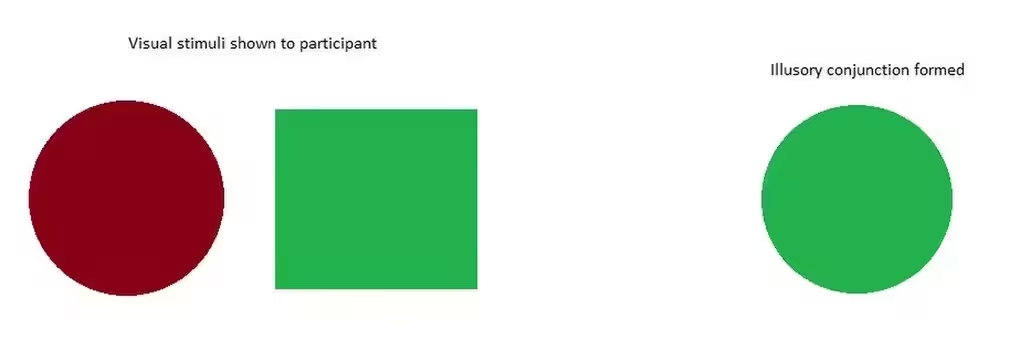
Example of an Illusory Conjunction between two different shapes of different colors forming an entirely new object
Introduction
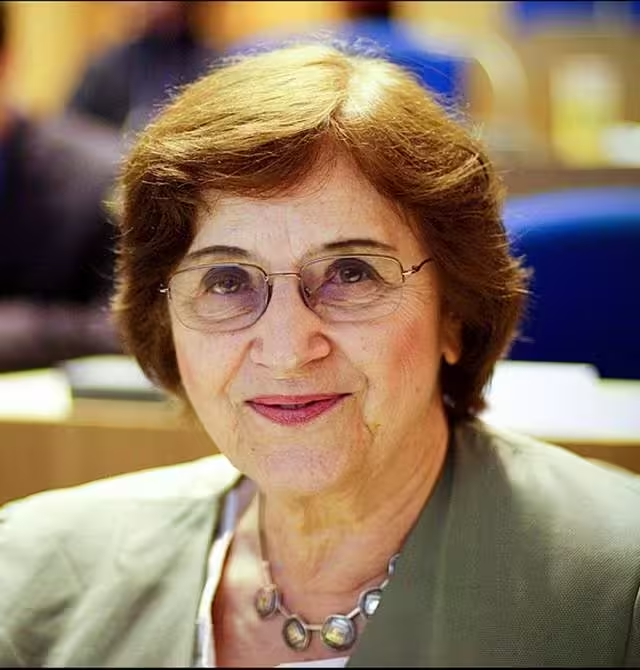
Anne Marie Treisman (27 February 1935 – 9 February 2018) was an English cognitive psychologist who spent five decades defining how the mind selects and combines information. Her first major contribution, the attenuation theory of selective attention, revised the dominant filter model of the 1950s by showing that unattended speech is weakened rather than switched off. Her second and more famous contribution, feature integration theory, developed with Garry Gelade in 1980, proposed that the visual system registers simple features such as colour, shape and orientation in parallel across the field, and that focused attention is needed to bind those features into the objects we perceive. Together the two theories made attention, rather than sensation, the central explanatory concept in the study of perception.
Treisman taught at the University of Oxford, the University of British Columbia, the University of California, Berkeley and Princeton University, where she was the James S. McDonnell Distinguished University Professor of Psychology until her retirement in 2010. Her 1980 paper with Gelade became one of the most cited articles in experimental psychology, and in 2013 President Barack Obama presented her with the National Medal of Science. She was married for much of her working life to Daniel Kahneman, with whom she also collaborated.
Early Life and Education
Treisman was born Anne Marie Taylor in Wakefield, Yorkshire, on 27 February 1935. Her father, Percy Taylor, was an education administrator who became chief education officer for the Medway towns in Kent; her mother, Suzanne Touren, was French, and Treisman remained fluent in French all her life. Early in the Second World War she, her mother and her younger sister were evacuated to Scotland, but the separation proved hard and the family returned to Kent, where their house stood under the flight path of the V1 flying bombs. When she was eleven the family moved to Reading, Berkshire, and she attended Kendrick School, a girls' grammar school. Because the English system of the time required pupils to narrow to three subjects in their final two years, she specialised in French, Latin and history, with no science at all.
She won a place at Newnham College, Cambridge, and took a first-class degree in French literature in the mid-1950s, an achievement that brought her a scholarship. She used it to stay on for a second bachelor's degree, this time in psychology. That single year decided her career: she worked under Richard Gregory, who introduced her to the experimental study of perception and to the idea that the mind could be investigated with carefully controlled demonstrations rather than argument. In 1957 she moved to Somerville College, Oxford, to begin a DPhil under Richard C. Oldfield. She began by studying aphasia but soon turned to healthy participants, drawn by Donald Broadbent's Perception and Communication and by the newly formulated problem of selective listening. She married Michel Treisman, a fellow Oxford graduate student, in 1960, and completed her thesis, "Selective Attention and Speech Perception," in 1962.
Academic and Professional Career
After her doctorate Treisman worked in the Medical Research Council's Psycholinguistics Research Unit at Oxford, where she pursued the selective-listening work that produced attenuation theory. In the 1970s her interests shifted from hearing to vision, and specifically to what came to be called the binding problem: if colour, form, motion and depth are handled by separate subsystems in the brain, why do we experience unified objects rather than a scatter of properties?
She and Kahneman moved to the University of British Columbia in 1978, to the University of California, Berkeley in 1986, and to Princeton University in 1993, where she was named the James S. McDonnell Distinguished University Professor of Psychology in 1995 and became emerita in 2010. At Berkeley and Princeton she built close-knit laboratories whose members included the later prominent researchers Nancy Kanwisher and Nilli Lavie. In retirement she moved full time to New York, where she continued to publish on how the visual system summarises sets of objects, and where she pursued her love of theatre, dance and opera. In 2015 a gift to Princeton established the Kahneman-Treisman Center for Behavioral Science and Public Policy. Treisman died of a stroke at her home in Manhattan on 9 February 2018, at the age of 82.
Major Contributions to Psychology
Attenuation theory of selective attention
Broadbent's filter model held that unattended auditory input is blocked early, before meaning is extracted. The model could not explain why a person reliably notices their own name spoken in an unattended channel. Treisman's 1964 attenuation theory replaced the all-or-none filter with a graded one: unattended material is attenuated, or turned down, rather than eliminated, and words with a low recognition threshold, such as one's own name or words primed by context, can still break through. The theory preserved the bottleneck idea while accounting for the intrusion of meaningful unattended speech, and it set the agenda for decades of dichotic listening research.
Feature integration theory
Feature integration theory, published with Gelade in 1980, proposed two stages. In the preattentive stage, basic features are registered automatically and in parallel across the visual field in separate feature maps, without any commitment to which object they belong to. In the focused-attention stage, a spotlight of attention scans locations and binds the features present at a given location into a coherent object. Preattentive processing explains why a red item among green ones seems to pop out regardless of how many distractors there are; the need for serial binding explains why finding a red circle among red squares and green circles takes longer the more items there are. The demonstration reproduced at the top of this page shows the theory's signature prediction: when attention is diverted, viewers shown a blue triangle and a red circle may report a blue circle and a red triangle. Treisman and Hilary Schmidt called these errors illusory conjunctions, and reported them in 1982.
Visual search and the guidance debate
Treisman's visual search experiments established the distinction between efficient "pop-out" search for a single feature and slow, effortful search for a conjunction of features, measured by how much response time increases with the number of items. This pattern became one of the standard tools for inferring what the visual system computes without attention. It also attracted the sharpest criticism of her career, discussed below.
Object files
With Kahneman and Brian Gibbs she proposed in 1992 that vision maintains temporary episodic representations of individual objects, called object files, which store the properties of an object and are updated as it moves. When a previewed letter is followed by a target at the same location, the visual system must decide whether it is dealing with the same object or a new one, and the costs and benefits of those two decisions could be measured. The idea connected her work on attention to questions about object continuity and to Kahneman's work on the psychology of the experiencing self.
Ensemble perception
In the last decade of her career, working with Sekuler, Chong and others, she showed that observers extract accurate statistical summaries, such as the mean size of a set of objects, even when they cannot report individual members, and that a broad distribution of attention improves these judgements. She treated statistical processing as a way for the visual system to represent sets economically without overloading focused attention.
Major Publications
- "Selective Attention and Speech Perception" (doctoral thesis, University of Oxford, 1962)
- "Selective attention in man," British Medical Bulletin (1964)
- "A feature-integration theory of attention," Cognitive Psychology (1980), with Garry Gelade
- "Illusory conjunctions in the perception of objects," Cognitive Psychology (1982), with Hilary Schmidt
- "Preattentive processing in vision," Computer Vision, Graphics, and Image Processing (1985)
- "Features and objects in visual processing," Scientific American (1986)
- "The reviewing of object files: Object-specific integration of information," Cognitive Psychology (1992), with Daniel Kahneman and Brian J. Gibbs
- "The binding problem," Current Opinion in Neurobiology (1996)
Impact and Legacy
Feature integration theory generated thousands of experiments in cognitive psychology, vision science, neuropsychology and cognitive neuroscience, and the National Medal of Science citation acknowledged her "enormous impact" both inside and outside psychology. The 1980 paper with Gelade has been cited well over ten thousand times. Applied researchers have used her findings to improve the discriminability of railway and traffic signals and to design training for airport baggage screeners, who search for conjunctions of shape and density under time pressure. Her work also helped to make attention a legitimate topic for neuroscientific investigation, by specifying behavioural signatures that could be looked for in the brain.
The theory was contested almost from the start, and Treisman's response to criticism became part of her scientific reputation. Jeremy Wolfe, then a young researcher, found in the mid-1980s that conjunction searches produced slopes far shallower than feature integration theory predicted, and published "Guided Search" as an alternative model. He and Treisman spent a long time trying to find the source of the discrepancy; it turned out to be technological, since her original stimuli had been hand-drawn with markers while his were displayed on early computer graphics with much higher contrast. She did not concede the field. She revised the theory to allow preattentive feature information to guide the deployment of serial attention, and in later years grew quietly irritated when critics continued to attack the 1980 model without acknowledging the revisions. Her students remembered her responding to each new attack with a grin and the words "Here we go again!"
The evidential status of illusory conjunctions has proved more stubbornly problematic than the search data. Yehoshua Tsal argued in 1989 that such errors may reflect failures of memory rather than of perception, and that the attentional manipulations in the classic experiments were too weak to establish the point; with Meiran and Lavie he published experiments in 1994 that failed to produce any true illusory conjunctions under a strong manipulation of attention. More recently, Henderson and McClelland, in a 2020 special issue marking forty years of feature integration theory, distinguished proximal illusory conjunctions, which they argued are largely explained by visual crowding, from distal ones, and proposed that the latter arise from an attentional shadow cast toward fixation rather than from the failure of a binding mechanism. Defenders of the theory reply that these accounts still require attention to maintain correct linkages between features and locations, which was Treisman's central claim, and that the two-stage architecture survives in modified form in most current models.
Treisman was elected a Fellow of the Royal Society in 1989, the US National Academy of Sciences in 1994, the American Academy of Arts and Sciences in 1995 and the American Philosophical Society in 2005. She received the Warren Medal of the Society of Experimental Psychologists in 1990, became the first psychologist to win the Golden Brain Award in 1996, received the University of Louisville Grawemeyer Award in Psychology in 2009, and held honorary degrees from the University of British Columbia and University College London.
Learn More
- Daniel Kahneman
- Donald Broadbent
- Michel Treisman
- Steven P. Tipper — whose negative priming work showed that ignoring is an active process with measurable aftereffects
References
- Treisman, A. M., & Gelade, G. (1980). A feature-integration theory of attention. Cognitive Psychology, 12(1), 97-136.