Justice Ruth Bader Ginsburg, Champion Of Gender Equality
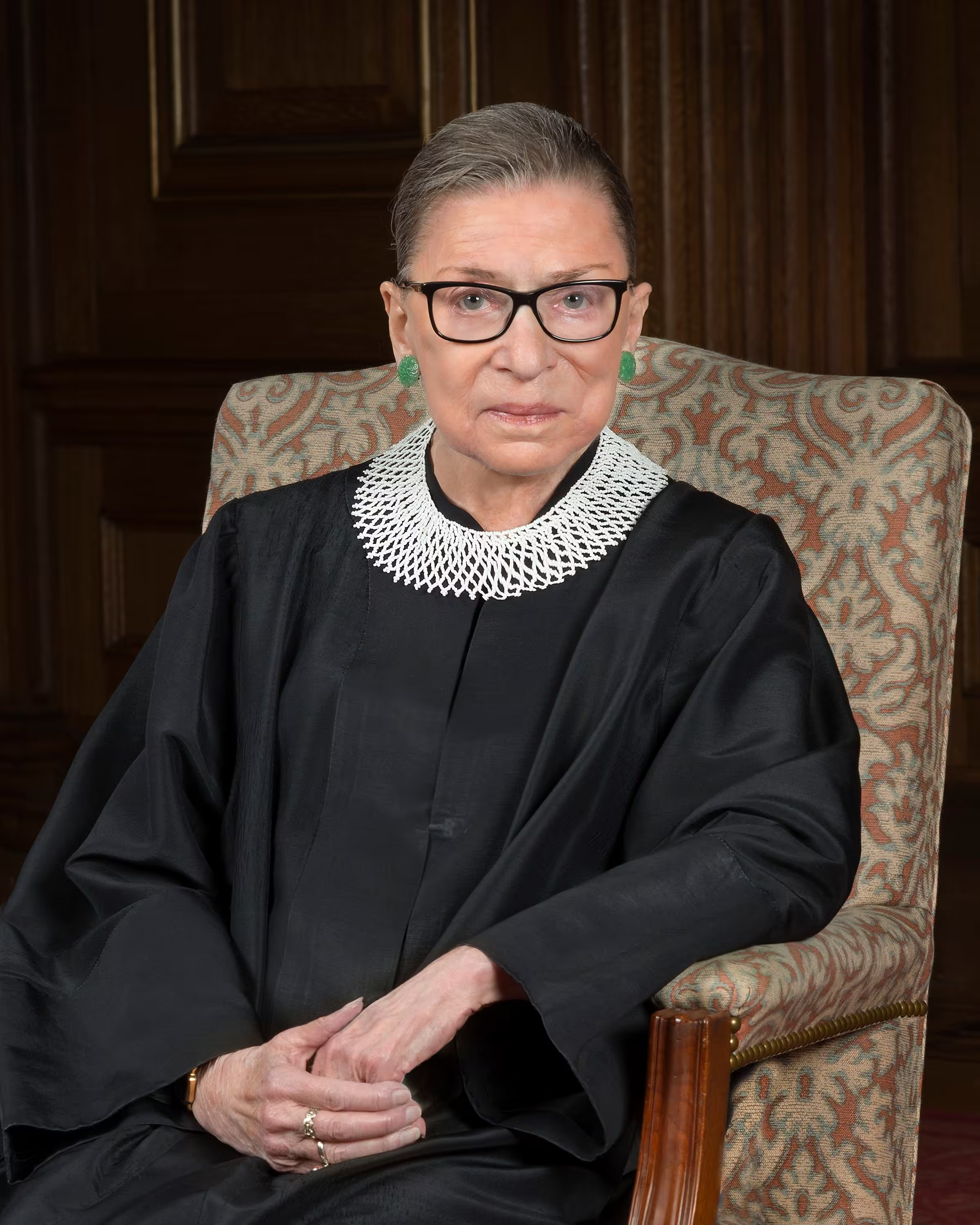
Ruth Bader Ginsburg (1933-2020) was a German-Jewish American jurist and a prominent advocate for gender equality. She served as an associate justice of the Supreme Court of the United States from 1993 until her passing in 2020.Nominated by President Bill Clinton, Ginsburg succeeded Justice Byron White and became the Court's first Jewish woman justice and the second woman overall, following Sandra Day O'Connor. Widely regarded as a liberal justice, she was a steadfast champion of women's reproductive rights. Prior to her Supreme Court tenure, Ginsburg had a distinguished career as a law professor and a lawyer specializing in women's rights. She was appointed to the U.S. Court of Appeals for the District of Columbia Circuit in 1980.
1 Early life and education
1933: Born Joan Ruth Bader in Brooklyn, New York City. Nicknamed "Kiki" by family.
1944: Renamed Ruth to avoid confusion with other girls named Joan at school.
1950: Graduated from James Madison High School; experienced the death of her mother, Celia, shortly before her graduation.
1954: Graduated from Cornell University with a Bachelor of Arts degree in Government, where she met Martin D. Ginsburg.
1955: Married Martin D. Ginsburg and gave birth to their first child, a daughter.
1956: Enrolled at Harvard Law School as one of only nine women in a class of approximately 500 men; faced sexism from faculty and students.
2 Legal Career Beginnings (1960-1963)
Initially faced employment challenges due to gender discrimination.
Clerked for Judge Edmund L. Palmieri at the U.S. District Court for the Southern District of New York from 1960, despite earlier rejections due to gender from Justice Felix Frankfurter.
Joined the Columbia Law School Project on International Procedure, serving as a research associate and later as associate director alongside Hans Smit.
Co-authored a book on civil procedure in Sweden, which influenced her views on gender equality.
3 Academia (1963-1980)
Started her academic career as a professor at Rutgers Law School in 1963, facing gender-based pay inequity.
One of the few female law professors in the U.S. at that time.
Co-founded the Women's Rights Law Reporter in 1970, the first U.S. law journal focused on women's rights.
Joined Columbia Law School in 1972, becoming the first tenured woman.
Co-authored the first law school casebook on sex discrimination.
Spent a year as a fellow at the Center for Advanced Study in the Behavioral Sciences at Stanford University (1977-1978).
4 Supreme Court tenure
Gender discrimination
Ruth Bader Ginsburg, a pivotal figure on the U.S. Supreme Court from 1993 until her death in 2020, championed gender equality and civil rights. Known for her landmark opinions, she authored the decision in United States v. Virginia (1996), which ended the Virginia Military Institute's male-only admissions policy, citing the Equal Protection Clause. Ginsburg's stance required a compelling justification for gender-based distinctions, rejecting proposed separate institutions for women as reminiscent of past segregation efforts.
Abortion rights
Ginsburg was a staunch advocate for abortion rights, supporting decisions like Stenberg v. Carhart (2000) that struck down restrictive laws. She criticized aspects of Roe v. Wade (1973), suggesting it prematurely curtailed evolving public discourse on abortion rights. In dissenting from Gonzales v. Carhart (2007), she challenged legislative findings limiting abortion procedures, emphasizing their dubious basis.
Religious Freedom
Ginsburg authored opinions in cases involving religious freedom, Fourth Amendment protections against unreasonable searches, and the use of international law in U.S. judicial decisions. Her tenure marked significant contributions to jurisprudence on voting rights, affirmative action, and Native American sovereignty, often advocating for expansive interpretations of federal protections and critical evaluations of historical legal doctrines affecting marginalized communities.
Search and seizure
In matters of search and seizure, Ginsburg's dissent in Board of Education v. Earls (2002) opposed mandatory drug testing for students in extracurricular activities, criticizing its broad application without evidence of significant drug risks. Her influence was also felt in Safford Unified School District v. Redding (2009), where she questioned the legality of a school strip-searching a 13-year-old girl, emphasizing the invasion of privacy and the need for sensitivity in such cases.
International law
In international law, Ginsburg advocated for using foreign legal principles for their persuasive value in U.S. courts, a stance reflected in her opinions on affirmative action and voting rights. Her dissent in Shelby County v. Holder (2013) underscored the importance of federal oversight in preventing discriminatory voting practices, likening it to discarding an umbrella in a rainstorm.
Native Americans
Ginsburg's contributions extended to Native American law, where her rulings on tribal jurisdiction and land rights, such as Strate v. A-1 Contractors (1997) and City of Sherrill v. Oneida Indian Nation of New York (2005), navigated complex legal terrain to balance historical claims with contemporary governance.
5 Recognition
In 2002, Ginsburg was inducted into the National Women's Hall of Fame. Ginsburg was named one of 100 Most Powerful Women (2009), one of Glamour magazine's Women of the Year 2012, and one of Time magazine's 100 most influential people (2015).
In 2009, Ginsburg received a Lifetime Achievement Award from Scribes—The American Society of Legal Writers.
Learn More
- Learn More About Women's Rights
- Learn More About Feminism
- Learn More About Feminist Psychology
- Learn More About History of Psychology
- Learn More About Psychology Research
- Learn More About Positive Psychology
- Learn More About Lifestyle with Positive Psychology
- All Psychologists — browse the full biographical collection.
References
- Ginsburg, R. B., & Kay, H. H. (1974). Sex discrimination and the law: Causes and remedies. Little, Brown.
- Reed v. Reed, 404 U.S. 71 (1971).
- Frontiero v. Richardson, 411 U.S. 677 (1973).
- United States v. Virginia, 518 U.S. 515 (1996).
- Stenberg v. Carhart, 530 U.S. 914 (2000).
- Shelby County v. Holder, 570 U.S. 529 (2013).