Mary Daly-a Leader in Feminist Theology
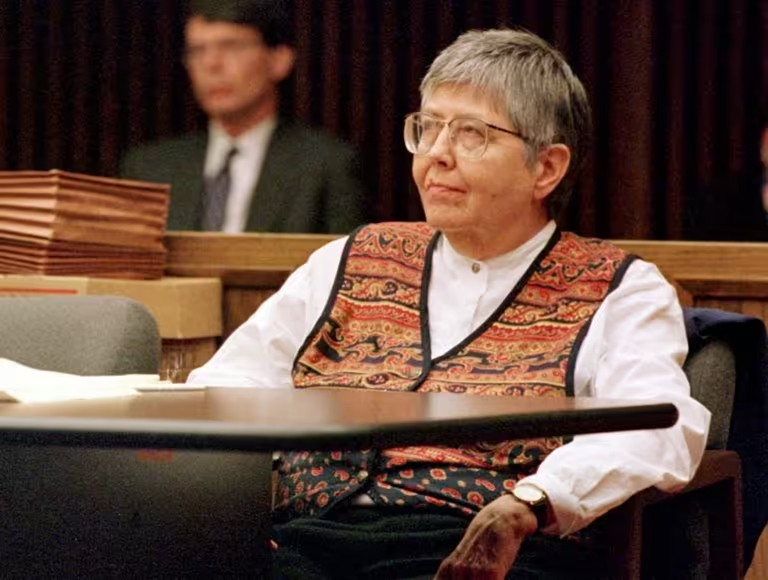
Mary Daly (October 16, 1928 - January 3, 2010) was an American radical feminist philosopher and theologian. Describing herself as a "radical lesbian feminist," she taught at Boston College, a Jesuit-run institution, for 33 years. Initially a practicing Roman Catholic, Daly renounced Christianity by the early 1970s. In 1999, she retired from Boston College after refusing to comply with university policy that required her to admit male students into her advanced women's studies classes.
1 Early life and education
Mary Daly was born in Schenectady, New York, on October 16, 1928.
Before obtaining her two doctorates in sacred theology and philosophy from the University of Fribourg, Switzerland, she received her Bachelor of Arts degree in English from the College of Saint Rose, her Master of Arts degree in English from the Catholic University of America, and a doctorate in religion from Saint Mary's College.
2 Career
Mary Daly taught classes at Boston College from 1967 to 1999, covering theology, feminist ethics, and patriarchy.
Following the publication of her first book, "The Church and the Second Sex" (1968), Daly faced potential dismissal when she received a terminal contract. However, due to strong support from the predominantly male student body and the public, she eventually gained tenure.
Daly's refusal to admit male students into some of her classes at Boston College led to disciplinary actions against her.
In 1989, Daly became an associate of the Women's Institute for Freedom of the Press.
In 1998, two male students filed a discrimination claim against Boston College, supported by the Center for Individual Rights, a libertarian advocacy group. The college responded by removing Daly's tenure rights, citing a verbal agreement with Daly to retire.
Mary Daly passed away on January 3, 2010, in Gardner, Massachusetts.
3 Theoretical point of view
Religion
Mary Daly began her career as a practicing Roman Catholic. In her early writings, she aimed to reform religion and advocate for women's equality within Catholicism by confronting injustices and calling for change. However, her perspective on religion evolved significantly over time. By the time she wrote "Beyond God the Father" in 1973, Daly had repudiated the Christian faith, viewing organized religion as inherently oppressive towards women.
By 1975, Daly identified herself as a "post-Christian feminist."
She eventually abandoned theology altogether, considering it irredeemably patriarchal, and shifted her focus to philosophical feminism. Despite her criticism, Daly retained a complex relationship with Catholicism; she cherished her copy of Summa Theologica even in her later years, acknowledging its influence on her early career.
Daly's upbringing in the Catholic Church initially inspired her career and subsequent work, even though she ultimately rejected its teachings. Her critiques paved the way for numerous feminist theologians who followed in her footsteps.
she criticized the "Equal Rights" feminist framework.
Men
The Church and the Second Sex (1968): Daly argued for gender equality within religious contexts.
Gyn/Ecology (1978): Daly posited that male culture is diametrically opposed to female nature, portraying men as agents of destruction against women's life-giving capacities.
Beyond God the Father (1973): While Daly still emphasized the importance of equality, she shifted towards highlighting sexual difference over strict gender parity.
Interview with What Is Enlightenment?(1999): Daly expressed a strong focus on women's empowerment, critiquing patriarchy for suppressing women's potential and advocating for their liberation and full realization.
Response to Sally Miller Gearhart's Proposal: Daly cautiously supported Gearhart's suggestion to reduce the male population, seeing it as potentially necessary for the survival of life on Earth.
Transgender persons
In Gyn/Ecology, Daly asserted her view of transgender persons, writing, "Today the Frankenstein phenomenon is omnipresent .... Transsexualism is an example of male surgical siring which invades the female world with substitutes."
4 Works
Beyond God the Father (1973)
In this seminal work of feminist theology, Mary Daly critiques androcentrism within Western religion. Drawing inspiration from existentialist theologians such as Paul Tillich, she constructs a systematic theology aimed at reclaiming "God-talk" for the women's liberation movement. Daly's playful writing style challenges patriarchal interpretations of divinity, marking a significant departure in feminist theological discourse.
Gyn/Ecology: The Metaethics of Radical Feminism (1978)
Expanding on her critique of patriarchy, Daly argues in Gyn/Ecology that women's historical oppression is deeply embedded in societal practices she equates to a religious system. She explores how these practices perpetuate male dominance and constructs a radical feminist metaethics that critiques the foundational structures of patriarchal society.
Pure Lust: Elemental Feminist Philosophy (1984)
In this work, Daly delves into feminist philosophy, emphasizing themes of exorcism and ecstasy as essential to women's liberation. She proposes an alternative language and conceptual framework to challenge patriarchal norms, advocating for the liberation of women's identities and experiences from male-dominated societal structures.
Websters' First New Intergalactic Wickedary of the English Language (1987)
Daly's Wickedary introduces a subversive lexicon aimed at deconstructing patriarchal language and redefining it from a feminist perspective. She provides definitions and chants intended to empower women to reclaim their identities from societal labels and oppressive norms. This work emphasizes the liberating potential of language in dismantling patriarchal hierarchies.
Each of Mary Daly's works contributes uniquely to feminist theory and theology, challenging readers to reconsider traditional interpretations of gender, power, and language within the context of patriarchal oppression.
5 Perspectives on Daly's work
Alice Echols, Linda Alcoff, and Elizabeth V. Spelman categorized Mary Daly's feminism as cultural rather than radical, contrasting with Daly's self-identification.
Julie Kubala criticized Daly's "Gyn/Ecology" for its essentialist view of gender, labeling it explicitly transphobic and implicitly racist.
The scholars in "Feminist Interpretations of Mary Daly" (2000) provided in-depth analyses and critiques of Daly's works and philosophy, examining various aspects of her feminist thought.
(1968). The Church and the second sex. New York: Harper & Row. OCLC 193755.
(1973). Beyond God the Father: Toward a Philosophy of Women's Liberation. Boston: Beacon Press. ISBN 978-0-8070-4164-2.
(1978). Gyn/ecology: The metaethics of radical feminism. Boston: Beacon Press. ISBN 0-8070-1510-5.
(1984). Pure Lust: Elemental Feminist Philosophy. Boston: Beacon Press. ISBN 0-8070-1504-0.(1992). Outercourse: The bedazzling voyage, containing recollections from my logbook of a radical feminist philosopher. San Francisco: Harper San Francisco. ISBN 0-06-250194-1.
(1998). Quintessence: Realizing the archaic future: A radical elemental feminist manifesto. Boston: Beacon Press. ISBN 0-8070-6790-3.
(2006). Amazon Grace: Re-calling the courage to sin big (1st ed.). New York: Palgrave MacMillan. ISBN 1-4039-6853-5.
Learn More
- Learn More About Women's Rights
- Learn More About Feminism
- Learn More About Feminist Psychology
- Learn More About History of Psychology
- Learn More About Psychology Research
- Learn More About Positive Psychology
- Learn More About Lifestyle with Positive Psychology
- All Psychologists — browse the full biographical collection.
References
- Daly, M. (1978). Gyn/Ecology. Beacon Press.